New Release: Queen Anna by Tony Riches

  Author Tony Riches has a new release... A crown won in the eye of a storm. A queen who refuses to be broken... Princess Anna of Denmark s...

Showing posts with label Amberley Books. Show all posts

Wednesday, 14 June 2023

Guest Post by Heather Darsie

Today I'm delighted to hand over the blog to a fellow Amberley Books author, Heather Darsie, whose new book, Children of the House of Cleves, Anna and Her Siblings, is out today:


Religion in the House of Cleves

by Heather R. Darsie, J.D.

Ah, religion. That sticky subject at dinner parties! The subject of religion was a very tense one in 16th century Germany. Anna of Cleves’ father Johann III of Cleves-Mark and mother Maria of Jülich-Berg did what they could to uphold Catholicism within the United Duhies in the wake of Martin Luther’s 95 Theses and the reforms it spawned,

“Johann III was against the spread of Lutheranism within the United Duchies. To … stop the spread of Lutheranism, an edict was issued in March 1525. This strategy worked for the most part, and Lutheranism was put down within Jülich-Cleves-Berg. Johann followed-up with an ordinance in July 1525, demonstrating his desire for reform of the Catholic church within his lands. Although Johann wished to remain on [Holy Roman Emperor] Charles V’s good side, he did not wish to aggressively eradicate Lutheranism. This strategy might be evidence of [Desiderius] Erasmus’s influence. It was not that the Catholic church was perfect, but rather that Luther and his followers were dangerous. …

…The same year as her marriage, 1527, Sybylla’[of Cleves’]s father-in-law John the Steadfast established the Evangelical-Lutheran State Church of Saxony after the Diet of Speyer. John was extremely active in establishing the principles of Reformation within Saxony, much to the chagrin of Charles V.”

The oldest and youngest Cleves siblings, Sybylla and Amalia, wound up being devoted to Lutheranism. Amalia was reportedly so faithful to Lutheranism that it was deemed impossible to find her a husband. Anna was Catholic, although how strong her actual faith was is unknown. Wilhelm, for his part, was Catholic when it suited him.

Even more confusingly, Wilhelm’s daughters were raised as Lutherans due to the influence of their aunt Amalia. Wilhelm reportedly flew into rages more than once at Amalia over her vehement support. Despite this rift in the family, Wilhelm had his poetic revenge on Amalia.

Image from Anna's prayer book: Trogen, Kantonsbibliothek Appenzell Ausserrhoden, CM Ms. 9, f. 12r – Gebetbuch der Anna von Kleve.


If this excerpt piqued your interest, consider reading Children of the House of Cleves: Anna and Her Siblings, set for release in the UK on 15 June 2023 and in the US/Internationally on 12 September 2023. Can’t wait until September? The US Kindle version is released on 15 June, too! 

Amazon UK (15th June 2023):

Hardback

Kindle 

Amazon US :

Hardback (12th September 2023)

Kindle (15th June 2023)


You might also like to read Heather R. Darsie’s biography on Anna of Cleves, the first researched and written from the German perspective, Anna, Duchess of Cleves: The King’s Beloved Sister. 

Amazon UK

Amazon US

[You can read Annie's review of Anna, Duchess of Cleves: The King's beloved Sister HERE]


Heather R. Darsie works as an attorney in the US. Along with her Juris Doctorate she has a BA in German, which was of great value in her research. She completed multiple graduate-level courses in Early Modern History, with her primary focus being the Holy Roman Empire under Charles V. She runs the website MaidensAndManuscripts.com, and is a co-host of Tudors Dynasty podcast.


Sources & Suggested Reading

1. Darsie, Heather R. Children of the House of Cleves: Anna and Her Siblings. Stroud: Amberley (2023).

2. Darsie, Heather R. Anna, Duchess of Cleves: The King’s Beloved Sister. Stroud: Amberley (2019).


Catch the rest of Heather's Blog tour:


Tuesday, 22 February 2022

Review: Philippa of Hainault/John of Gaunt by Kathryn Warner

Serendipitously, the paperback version of Philippa of Hainault and the hardback version of John of Gaunt (Philippa's son) came out at similar times, and the lovely people at Amberley sent me copies of both.

Of course, I started with the biography of Philippa. I found Warner's approach refreshing, and very much enjoyed reading the personal story of the wife of Edward III, beginning with what is known of her childhood and the very difficult early years of her marriage when she and Edward were very much in the shadow of his mother and her co-conspirator Mortimer.

What came across so strongly in Warner's narrative is the personalities of those involved in the stories. Whilst the author debunks many myths, including the claim that Isabella and Mortimer were lovers, she imbues her story with anecdotes and snippets which give glimpses into the characters of the people involved. I was left with a clear impression about the nature of Philippa and her husband and they are presented as rounded personalities, while the author remains analytical, sticks to the known facts and cites primary sources without wandering off into any reveries about what they might have done/thought/said. Warner is a skilled narrator indeed.

I felt, however, that the author might have their work cut out in endearing me to John of Gaunt. To me he's never been an attractive character, but it's so rare to be able to read a biography about one historical character and then straight away dive into one about their son, that I was intrigued. Warner gives John of Gaunt a fair treatment, by which I mean all the reasons for his unpopularity are laid out but again, we are given touching little details, such as his proven devotion to his mother. Also detailed and interesting was the examination of Gaunt's relationships with Blanche of Lancaster and Katherine Swynford.

Both of these books are excellent history books, but they are more than that. They are stories of real people, who come to life. I'd not read works by Kathryn Warner before. She is now one of those whose books I'll automatically read, regardless of the title, because I'm so impressed by the way she approaches her subject matter.

Many thanks to Amberley for providing review copies.

Find the author's books here

Wednesday, 22 September 2021

Review - Henry II and Eleanor of Aquitaine: Founding an Empire, Matthew Lewis

I was delighted to receive a review copy of this new book by Matthew Lewis.

"Henry II became King of England in 1154 after twenty years of civil war. He was the first Plantagenet king, the founder of England’s most successful and longest-ruling dynasty. But Henry did not come to the throne alone. He had married Eleanor of Aquitaine, a feisty, formidable and powerful woman ten years his senior. Eleanor had spent fifteen years married to Louis VII of France before he divorced her, only to be angered when she married his young rival. Together, they were a medieval power couple who soon added the ultimate rank of king and queen consort to their list of titles. With them, the Angevin Empire was born. Over the decades, a wedge was driven between the king, fiercely protective of his empire, and Eleanor, who felt restrained in her husband’s shadow. Henry imprisoned his wife, fought his elder sons and pinned his hopes on his youngest, whose betrayal was the last straw. This book charts the early lives of Henry and Eleanor before they became a European power couple and examines the impact of their union on contemporaries and European politics. It explores the birth of the Angevin Empire that spread from Northumberland to the Mediterranean, and the causes of the disintegration of that vast territory, as well as the troublesome relationships between Henry and his sons, who dragged their father to the battlefield to defend his lands from their ambitious intriguing."

I suppose I've read more than a few books about Eleanor over the years, but outside the world of fiction, I don't think I've read one that gives equal 'billing' to both Eleanor and her second husband, Henry II.

Two things struck me immediately: the author is adept at analysing  primary sources, and he writes in a very conversational style, presenting the carefully researched history in a very readable way. Not once did I have to stop, go back, and re-read a passage. Even the complicated relationship between Henry and Thomas Becket flows beautifully (with some excellent suggestions regarding what might have been going through Becket's mind).

The author is clearly an admirer of Eleanor and is at pains to point out several times that she was the victim of the misogynistic attitudes of the age. 

This is not to say that he is unsympathetic towards Henry. On balance, the impression is that he greatly admires both the separate and joint achievements of this couple. He also throws doubt (or should that be light?) on some of the accepted 'truths' about their marriage, which I found refreshing and thought-provoking.

One aspect which comes across strongly is the complex system of fealty in what we think of today as France but was back then a collection of duchies and counties with rulers who owed allegiance often to more than one lord for their various landholdings. In this, Henry was no different and the struggle to hold those lands (at the author says in his summing up, it was not a deliberate decision to build an empire, more a lucky amassing of lands through various inheritances).

I thought I was fairly familiar with the lives of these two, but I have to say that, especially when debunking accepted ideas about them, the author convinced me with his logical, source-based conclusions and often challenged my pre-conceptions.

This book is a thorough examination of the lives and fluctuating fortunes of Eleanor and Henry, and shows what happened when their children grew to adulthood, offering reasons for what went so wrong. It's an engaging read, packed with detail, and I highly recommend it. 

Available now from Amberley Books

and Amazon

Tuesday, 10 August 2021

Review: The Man in the Iron Mask by Josephine Wilkinson

 Once again, the lovely folks at Amberley Books have sent me a review copy of one of their latest titles, and it's been a thrill to read this one.


"The Man in the Iron Mask has all the hallmarks of a thrilling adventure story: a glamorous and all-powerful king, ambitious ministers, a cruel and despotic gaoler, dark and sinister dungeons - and a secret prisoner. It is easy for forget that this story, made famous by Alexandre Dumas, is that of a real person, who spent more than thirty years in the prison system of Louis XIV’s France never to be freed.

This book brings to life the true story of this mysterious man and follows his journey through four prisons and across decades of time. It introduces the reader to those with whom he shared his imprisonment, those who had charge of him and those who decided his fate.

The Man in the Iron Mask is one of the most enduring mysteries of Louis XIV’s reign, but, above all, it is a human story. Using contemporary documents, this book shows what life was really like for state prisoners in seventeenth-century France and offers tantalising insight into why this mysterious man was arrested and why, several years later, his story would become one of France’s most intriguing legends."

There is no preamble. Dr Wilkinson dives straight in and tells us how the story began, with a letter sent to the man who would be the prisoner's gaoler. Saint-Mars is, in some ways, the main character of this story, and we meet him when he receives a letter from the man with whom he will correspond for decades: Louvois writes with details of the arrangements for the prisoner who, at first, is named as Eustache Dauger.

There is so much rich detail in this book and so much to praise that I barely know where to start. We don't hear much about Eustache really, for each chapter of the books introduces us to the other prisoners as each arrives at Pignerol, to be held securely. Very securely, in most cases. We are spared nothing, and learn how truly isolated these hapless souls were; not allowed to speak, or at some points even to see out of the windows. Nevertheless, some extraordinarily ambitious attempts are made to communicate with the outside world, and even to escape. The ingenuity is to be admired. Some prisoners sink, understandably, into despair, some into madness. We learn their backgrounds, how they came to be incarcerated and, as well as their daring exploits, we learn what happened to them: in some cases they were eventually freed, while some died in prison.

The politics of the age are presented where necessary, but the focus is on Saint-Mars, Louvois, and the prisoners. Conditions are not harsh as far as their personal needs are concerned - they are fed and clothed and provided with furniture according to their rank - but because of their secrets, they must be kept isolated. This is especially difficult for those who are assigned valet duties. These valets were effectively locked up too and it's unsurprising that there were few volunteers for the job. At one point, therefore, the mysterious Eustache is appointed as a valet.

Thus, as we are told the sad stories of the prisoners, we also see that Eustache is there, hovering in the background. When Saint-Mars is moved to new prisons, he takes his charges with him, from Pignerol to Exilles to the Isle de Sainte-Marguerite and finally to the Bastille. By this time, he has only one prisoner with him, and that prisoner no longer even has a name. Why? What happened? And who was Eustache really?

By telling us what is known of all the prisoners who came under the watchful eye of Saint-Mars, Dr Wilkinson gives, via this focus, a clear picture of the wider world of the France of Louis XIV. We learn what is important, what will be tolerated, and what can get people into trouble. Money and connections will get a person only so far, it seems. We are at times uncomfortably close witnesses to the despair of the prisoners, of the tedium of their existence, their delight when granted privileges, be it to take a walk, or, eventually, to receive visitors. Sources and letters (carefully and insightfully analysed), are quoted often and at length, which only adds to the compelling narrative and never bogs it down. 

What of THE prisoner? For much of the book it might seem that this is not his story, but that of the other prisoners. And yet, cleverly, Dr Wilkinson ensures that he is always there, shows how his fate is tied in with that of the others and, when she presents the myths versus the likely truth, it all comes together beautifully; this or that suggested theory cannot be true, she will point out because, remember, we have already been told where the key players were at that point. 

I never had any doubt that all the threads of the story would be pulled together for a satisfying conclusion but there were still a few surprises. I often think the term 'page-turner' is over used, but in this case it is apt. I really was gripped. Not even so much because of the mystery element, but simply because it's rare to feel so much for the characters, and to be able to 'see' the historical setting so clearly in nonfiction. I found that I was so wrapped up in these people's stories that I had no choice but to keep reading. 

I am left with two overriding feelings. The first is that this story, compelling though it is, is one of sadness and cruelty and I'm not surprised so many succumbed to madness and mortal illness. The other is that this is a fascinating tale, expertly told.


Available for pre-order now at

Amberley

Amazon

and published on August 15th 2021

Wednesday, 23 June 2021

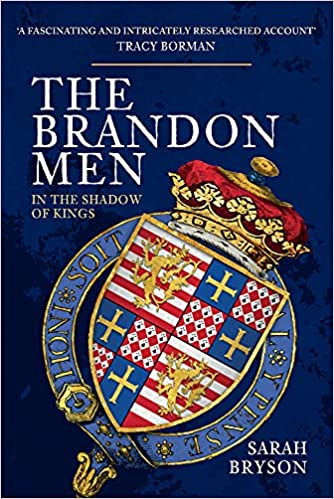
Review: The Brandon Men - Sarah Bryson


Sarah Bryson's new book, The Brandon Men: In the Shadow of Kings, has an interesting title. I knew, or thought I knew, about Charles Brandon, Duke of Suffolk. So who were the others?

Of course, when one stops to think, Charles Brandon didn't appear from nowhere. As the blurb for this excellent new book says:

Four generations of Brandon men lived and served six English kings, the most famous being Charles Brandon, Duke of Suffolk, best friend and brother-in-law to King Henry VIII. Yet his family had a long history tied closely to the kings of the Wars of the Roses back to Henry VI. Charles Brandon’s father, Sir William Brandon, supported Henry Tudor’s claim on the throne and became his standard bearer, dying at the Battle of Bosworth. Charles’s uncle, Sir Thomas Brandon, was Henry VII’s Master of the Horse, one of the three highest positions within the court. Charles’s grandfather had ties with Henry VI, Edward IV and Richard III. These men held important offices, made great sacrifices, walked the fine line between being loyal courtiers and traitors, and even gave their lives, all in the name of loyalty to the king they served. No more shall the Brandon name be an obscure reference in archives. It is time for them to emerge from the shadows of history.

The author explains at the outset that of the earlier Brandon men, there is less in the way of historical record, but she makes the most of what is available, detailing as vividly as possible the careers of the men who brought the family up from rather humble beginnings to the highpoint at which Charles Brandon became Henry VIII's trusted friend.

What is evident is that this was far from a foregone conclusion. As Ms Bryson points out, Sir William Brandon II was the only member of the nobility on Henry Tudor's side to be killed at Bosworth. This left his wife, and her son Charles, then only one, in somewhat of a precarious position.

However, Charles Brandon thrived and, inevitably, most of the book's pages are taken up with his story. Some of it, such as his treasonous marriage to Henry VIII's sister, I knew, but this very readable book gives the background to that, tells us about Charles' earlier and subsequent marriages, and explains, wherever possible, what happened to the various Brandon women, too.

There is also extensive detail about his dealings in East Anglia, his diplomatic missions and military enterprises, and what comes across is a real sense of his character. Whilst reading, I felt I was really getting to know the man.

It's easy, I suppose, to assume that Charles was just another rich playboy at the young Henry VIII's court and this simply isn't the case. His family had risen through loyal service and Charles fared better than many of Henry's friends for, as the author points out, he knew Henry the man, as well as Henry the king. He wasn't universally liked, but he kept his head, and the friendship of the king where others failed in both those respects.

It is astonishing that a family could rise to such lofty heights in relatively few generations, and sobering that it all fell away so quickly, too.

Ms Bryson has a very engaging style, and the book, whilst being packed with historical detail and lengthy quotations from primary source documents, is also an easy and enjoyable read.

Highly recommended.

[Thank you to Amberley Books for providing me with an advance copy, with no obligation to review.]


The book is available from:

Amberley Books

Amazon 


Friday, 15 March 2019

Review - Edward the Elder: King of the Anglo-Saxons: Forgotten Son of Alfred

'Edward the Elder succeeded his father Alfred the Great to the kingdom of Wessex, but was largely overlooked by his contemporaries (at least in terms of the historical record) and to a greater or lesser extent by later historians. He is the forgotten son of Alfred. Edward deserves to be recognised for his contribution to Anglo-Saxon history and a new assessment of his reign is overdue.'

So begins the blurb for this new book and I heartily concur with the sentiment. Having written about Edward's sister myself in both fiction and nonfiction, I had played with the idea of pitching a proposal to my publisher, suggesting a book about Edward. Had I done so, I would have discovered that they had this book already in production, so when I was offered a review copy, I immediately said 'Yes please'.


As I know only too well, there are very few books about Edward and he has been overshadowed by his much more famous father. I've always thought that this was an injustice which needed rectifying. Michael John Key's book does this admirably.

It states that it is a 'popular' history of Edward but I disagree. I think this is a scholarly work by an author who has been at great pains to ensure that he lets the evidence speak for itself. Much use is made of the primary sources, and the bibliography and notes (which give page numbers) are useful for students and anyone would like to read further. Scholarly, yes, but very readable and accessible too.

Edward's childhood, the campaigns when his father was still alive, and the partnership with his sister Æthelflæd, Lady of the Mercians, are examined in detail and laid out in chronological order. Other aspects of Edward's reign are explored too, however, so that we get an account of his administration as well.


Often when I was reading the book I found myself nodding in agreement. That Edward was less inclined than his father to compromise made him - in my view and the author's - an ultimately more successful military leader. 

On some occasions I also found myself disagreeing. Some of the conclusions about Edward's sister and his dealings with her, for example, run counter to my own assessments, but Mr Key is clearly skilful at reading and using the primary source material and this wouldn't be the first time when two historians have looked at the same material and come to different conclusions. 

In fact, I had only two very slight niggles. The first is a sentence in which it is stated that 'by all accounts' Athelstan was educated by Æthelflæd and her husband Æthelred, when in fact there is only one, post-Conquest, source which says so. However, it is generally accepted that this was the case and this may, in fact, be the author's intended meaning. My second niggle is the use throughout of infer instead of imply. But it says a great deal about this book that those are my only noted negative points.

Mr Key provides excellent analysis of the policy of burh-building. We are not only given details of the strategy, but much investigative work has gone into producing great detail too about the physical buildings and the locations thereof. I found this section of the book particularly interesting and informative. His analysis of this policy was insightful. Judging from the colour plate section, the author has visited many of the locations and his knowledge of the lie of the land informs this analysis.

This is not, as I said earlier, simply a story of the of the military campaigns. The point is made that study of the last fifteen years of Edward's reign is hampered by the lack of charters; nevertheless, the author turns to other sources to glean as much information as possible. 

It is hard to know what else could have been included in this book, because for me it is a thorough and complete examination of Edward. It is written in an easy style, terminology is explained for those readers who might be new to the subject or indeed the period, and there is rich juicy detail for those who already know much of the basics of Edward's life and times. His legacy is also discussed, and after reading this book, surely no one can disagree with the assessment that Edward 'should be acknowledged as a great Anglo-Saxon king in his own right, and is entitled to stand comparison with every English monarch that has passed since his reign.'

I recommend this book to anyone interested in Anglo-Saxon and/or military history.  

Buy from:

Amazon

Amberley


Wednesday, 15 August 2018

Review: Pirates - Truth and Tales - by Helen Hollick

Let me start this review with a confession. I've not ever been a huge fan of pirates. I watched the first Pirates of the Caribbean film and couldn't even follow the plot. So I wasn't sure how I'd react to this book. 

I needn't have worried. For a start, the book sets the reader very straight about the difference between what we think we know about pirates, and the historical truth.

Ms Hollick has written a series of novels about pirates, or, more correctly, about a particular pirate: Jesemiah Acorne. No one could, or should, write historical novels without doing thorough research, and it's clear that the author has done her homework.


This book gives a detailed, informative and interesting history of piracy. Sometimes of piracy in general, and sometimes giving short biographies of some of the more famous names - Calico Jack, Mary Read, Anne Bonny - and some less well-knowns - Jan Baert, William Fly.

But this book is not just a good, solid, well-researched book about the history of pirates. It is also a book which you can dip in and out of, including as it does excerpts from novels, recipes - for Damson Rum, yum! - sea shanties, a glossary of pirate 'speak', of terminology, and lists of pirates' ships and their colours.

Packed full of interesting information, the book gives the reader plenty of  'Well, I didn't know that!' moments. I rather regret that I was on my own when I was reading it, because there were many times when I wanted to say to someone, 'Did you know the origin of the phrase...' 

There were many times when I also chuckled aloud. Not just at the information, but at the light delivery. Ms Hollick is such an enthusiastic writer, and the book's tone is warm, friendly, but never less than informative.

Every aspect of this life is explored - the depiction of pirates in film, television and novels, what 'gaol' meant, the difference between sailors and tars, how they navigated across the seas. We even learn why pirates all seem to be portrayed as speaking in the traditional 'arrr' way. It's all fascinating stuff.

Ms Hollick has pulled off a difficult feat, giving us solid history and an accessible and highly entertaining read. So, although I began thinking I wasn't a fan of pirates, I can't recommend this book highly enough. It even gives a history of rum. Cheers!


Helen recently took off on a voyage of her own, not across the high seas, but across the blogosphere. She weighed anchor on this blog on August 3rd, where she talked about the Vikings. You can read that post HERE where you'll also find links to all the other ports of call on her voyage.

And you can buy Pirates, and all of Helen's novels at http://viewauthor.at/HelenHollick

Friday, 3 August 2018

The Vikings: Raiders or Pirates?

I'm delighted to host author Helen Hollick as she embarks on a voyage across the blogosphere.


Helen has written a series of nautical Voyages based around her fictional pirate, Captain Jesamiah Acorne and his ship, Sea Witch, but her latest UK release in paperback is a non-fiction book – Pirates: Truth and Tales published by Amberley Press, which explores our fascination with the real pirates and those who are favourites in fiction. Today, Helen drops anchor for another interesting addition to her on-line two-week Voyage around the Blogs with a pirate or two for company…


~~~~~~~~~~~~~~~~~~~~~~~~~~~

Raiders? Pirates? Sea Wolves? For the people concerned at the time, I doubt they particularly cared what these terrifying men from the sea were called! To the Anglo-Saxons they were ‘the Danes.’ For the Franks, ‘Northmen’; to the Irish, just ‘foreigners.’ The Slavs knew them as ‘Rus,’ from which we get ‘Russian,’ and the Spanish kept it simple: they were ‘The Heathens.’ Between themselves the ‘Vikings’ were named for the area they came from. What they were not called by their contemporaries was ‘Vikings.’ That term came to be used somewhat later in history.

The word ‘i-viking’ means something like ‘to go raiding’, and basically that is what these skilled seamen from the Scandinavian countries were, expert seamen and part-time raiders. Unlike the Johnny Depp/Jack Sparrow type Pirates of the Caribbean of the early 1700s, the Vikings did not roam the seas in deliberate search of merchant ships, or heavily-laden Spanish treasure ships to prey upon. Nor were the Vikings like the eighteenth century pirates who were deserters and ne-er-do-wells. The Vikings were skilled warriors and even more skilled sailors, with a superb knowledge of seamanship and navigation. They came from Norway, Sweden and Denmark and were a massive nuisance for England for three centuries from about the mid-700s. (They were known and feared in many other countries as well, but I’m sticking to England for this article.) They were finally ‘tamed’ (as far as England was concerned) because of the Norman Conquest by Duke William of Normandy when he won at the Battle of Hastings in 1066. Incidentally, ‘Norman’ derives from 'North Man’, the Normans were, in fact, descendants of Viking raiders.


In 1002, King Æthelred II (the Unready) took Emma, the daughter of Duke Richard I of Normandy, as his wife. His intention was to seal a treaty to ensure that Normandy would cease allowing Vikings to overwinter along the Normandy coast from where they preyed on England. The idea did not work. Æthelred ended up paying the Danes more and more money to ‘go away’ and eventually one Danish King, Cnut, ended up as King of England… married to Æthelred’s widow. Her son by Æthelred, in turn, became King of England in 1052. His name was Edward – later known as the Confessor. 

The Anglo-Saxon Chronicle makes much of one of the first (recorded) raids on the English coast by Vikings when it mentions: “…on the ides of June the harrying heathen destroyed God’s church on Lindisfarne by rapine and slaughter.” This was in 793, with Lindisfarne one of the holiest places outside of Rome. The attack was witnessed by a monk, Simon of Durham, “… laid everything waste with grievous plundering, trampled the holy places with polluted feet, dug up the altars and seized all the treasures of the holy church. They killed some of the brothers; some they took away with them in fetters; many they drove out, naked and loaded with insults; and some they drowned in the sea.”

Whether using the term ‘raiding’ or ‘piracy’, the Vikings never intentionally aimed at desecrating the Christian God. Religion had nothing to do with it: a stockpile of gold and riches, virtually undefended, was the sole lure.

In 795, Iona, an island off the west coast of Scotland, was raided, then again in 802 and 806, the latter of which saw sixty-eight monks and laymen slaughtered. Ireland, Wales and the other islands of Scotland were also frequently raided. One of the Norse raiders who plundered the Hebrides was Svein Asleifarson. After his raiding on the islands, he sailed to Dublin, capturing two merchant ships en-route and relieving them of their cargo – fine quality broadcloth. Ah, now that was piracy!

Those early raids soon expanded into actual settlement when the Norse started to establish suitable bases for overwintering; places like York, Dublin, Normandy and Novgorod. Their ships – the Longships – were well-built powerful craft with a low, sleek appearance that could glide through the sea or along shallow rivers. They could be easily beached and were light enough to be carried over land if necessary. A rudder was on the steerboard side (which later became ‘starboard’) and had a single mast and sail. No wind? The crew rowed. 

To the astonishment of some experimental archaeologists who had re-crated a full-size longship, during trials they discovered that these ships were capable of being very fast, in fact the accompanying in-shore motor-powered lifeboat had to radio them to slow down – they couldn’t keep up! It was also discovered that in the right conditions and if enough speed was reached the longboat would aquaplane for several yards: row, row, row… skim… row, row, row…skim… 
I think the word formidable fits in here rather nicely!

But were the Vikings opportunists raiders, or were they ruffian pirates? I’ll leave you to decide.

© Helen Hollick

Pirates: Truth And Tales published in paperback in the UK July 2018 and November 2018 in the US – but available for pre-order.

Buy the Books: Amazon Author Page (Universal Link) 
http://viewauthor.at/HelenHollick

Sign up for Helen’s Newsletter and be entered for an annual prize draw. 
One name ‘picked from the hat’ in December will win a £10/$10 Amazon gift voucher.
Subscribe here: http://tinyletter.com/HelenHollick

LINKS:
Website: www.helenhollick.net
Main Blog: www.ofhistoryandkings.blogspot.com
Facebook: www.facebook.com/HelenHollickAuthor 
Twitter: @HelenHollick
Discovering Diamonds: https://discoveringdiamonds.blogspot.co.uk/

Follow Helen’s Tour:
These links will take you to the Home Page of each blog host – Helen says thank you for their interest and enthusiasm! For exact URL links to each article go to Helen’s website:  www.helenhollick.net  which will be updated every day of the tour.


30th July: Cryssa Bazos Dropping Anchor to Talk About Pirates
31st July: Anna Belfrage  Ships That Pass…
1st August: Carolyn Hughes Pirates of the Middle Ages
2nd August: Alison Morton From Pirate to Emperor
3rd August: Annie Whitehead The Vikings: Raiders or Pirates?
4th August: Tony Riches An Interview With Helen Hollick (and maybe a couple of pirates thrown in for good measure?)
5th August: Lucienne Boyce Anne and Mary. Pirates.
6th August: Laura Pilli Why Pirates?
7th August: Mary Tod That Essential Element… For A Pirate. 
8th August: Pauline Barclay Writing Non-Fiction. How Hard Can It Be?    
9th August: Nicola Smith Pirates: The Tales Mixed With The Truth
10th August: Christoph Fischer In The Shadow Of The Gallows
11th August: Debdatta What Is It About Pirates?
12th August: Discovering Diamonds It’s Been An Interesting Voyage…
13th August: Sarah Greenwood Amberley Books blog Pirates: The Truth and the Tales 
14th August: Antoine Vanner The Man Who Knew About Pirates


ABOUT HELEN:


Helen moved from London in 2013 and now lives with her family in North Devon, in an eighteenth century farmhouse. First published in 1994, her passion now is her pirate character, Captain Jesamiah Acorne of the nautical adventure series, The Sea Witch Voyages. Helen became a USA Today Bestseller with her historical novel, The Forever Queen (UK title A Hollow Crown) the story of Saxon Queen, Emma of Normandy. Her novel Harold the King (US title I Am The Chosen King) explores the events that led to the 1066 Battle of Hastings. Her Pendragon’s Banner Trilogy, set in the fifth century, is widely praised as a more down-to-earth historical version of the Arthurian legend. She has written three non-fiction books, Pirates: Truth and Tales, Smugglers in Fact and Fiction (to be published 2019) and as a supporter of indie writers, co-wrote Discovering the Diamond with her editor, Jo Field, a short advice guide for new writers. She runs the Discovering Diamonds review blog for historical fiction assisted by a team of enthusiastic reviewers.  
Helen is published in various languages. 

Tuesday, 29 May 2018

Review: Women in Medieval England by Lynda Telford

I am privileged to have received a pre-publication copy of this wonderful new book by Lynda Telford, a fellow Amberley author.


Perhaps I should start this review by quoting a section of the press-release:

'The author starts by contrasting the differences in status between Anglo-Danish or Saxon women with those who fell under the burden of the feudal system imposed by the Normans. She covers such subjects as marriage and childbirth, the rights an responsibilities of wives, separation and divorce, safety and security and the challenges of widowhood.'

The first chapter drew me in immediately. 'The Loss of Equality' gives an overview of the status and general lot of pre-Conquest women. I spend my life writing and reading about Anglo-Saxon England, so there were few surprises here for me. The chapter provides a good overview, although it is not reign-specific. However, the author makes good use of the law codes, which is where we find most of the information about the rights of women at this time. There is always something new to ponder, and the author makes a particularly good point, and one which I've not heard mooted before, regarding the changes which came about after 1066. She says that the noble widows, forced to marry new Norman overlords, might at least have had a rudimentary understanding of the language - there were many Normans at the court of Edward the Confessor, who had himself spent many years in Normandy - but the 'peasantry' would not have had any grasp at all of the foreign language. How truly terrifying that must have been.

Of course, the main focus of the book is the fate of women after the Normans took control, and the subsequent chapters contain a wealth of information about how women lived and what was expected of them. Nuggets of information include discussions about what exactly constituted marriage, and the fact that it was not uncommon for two women to claim consummation with the same man.

In Chapter Three we learn of rather unusual, but quite logical, methods of contraception and some rather brutal cures for male impotence, including one which might have worked, but resulted in a crop of nettle stings. Ouch!

This is not a 'sensational' book in that sense, however. The horrors of childbirth, while told in unflinching detail, serve only to demonstrate how precarious life was.

The legal status of married women is explored in detail, and we learn how much women were supposed to defer to their husbands, and how much and often their husbands could chastise them. (I had not hitherto known the derivation of the phrase 'rule of thumb'.)

Although this is a general history, looking at the plight and situation of women across the social spectrum, it is liberally peppered with examples of individual stories, and is the richer for it. We also learn some interesting specifics: in 1422, women who sold fish were not allowed to oversee the trading in oysters in London's Queenhithe. We also learn of the opportunities which opened up for survivors of the Black Death.

This is a thoroughly researched book, an easy read, but packed full of information. Some of it familiar, but much of it new, certainly to this reader. As with the first chapter, that information is presented in a thematic way, and not reign-specific. Because I not only read about history, but use books for my own study and research, I would have preferred a little more detail about how life changed for women, not only post-Conquest, but in the subsequent centuries covered in this book.

In that vein, I would also have preferred a little more information in the notes at the back of the book, where only the names of the source books are given, and not the relevant page numbers. For those wishing to pursue further study, this will be frustrating.

All in all, an accessible book which provides masses of detail in an extremely readable way. I'd heartily recommend it to anyone interested in learning more about the role, status and general lot of women in medieval England.