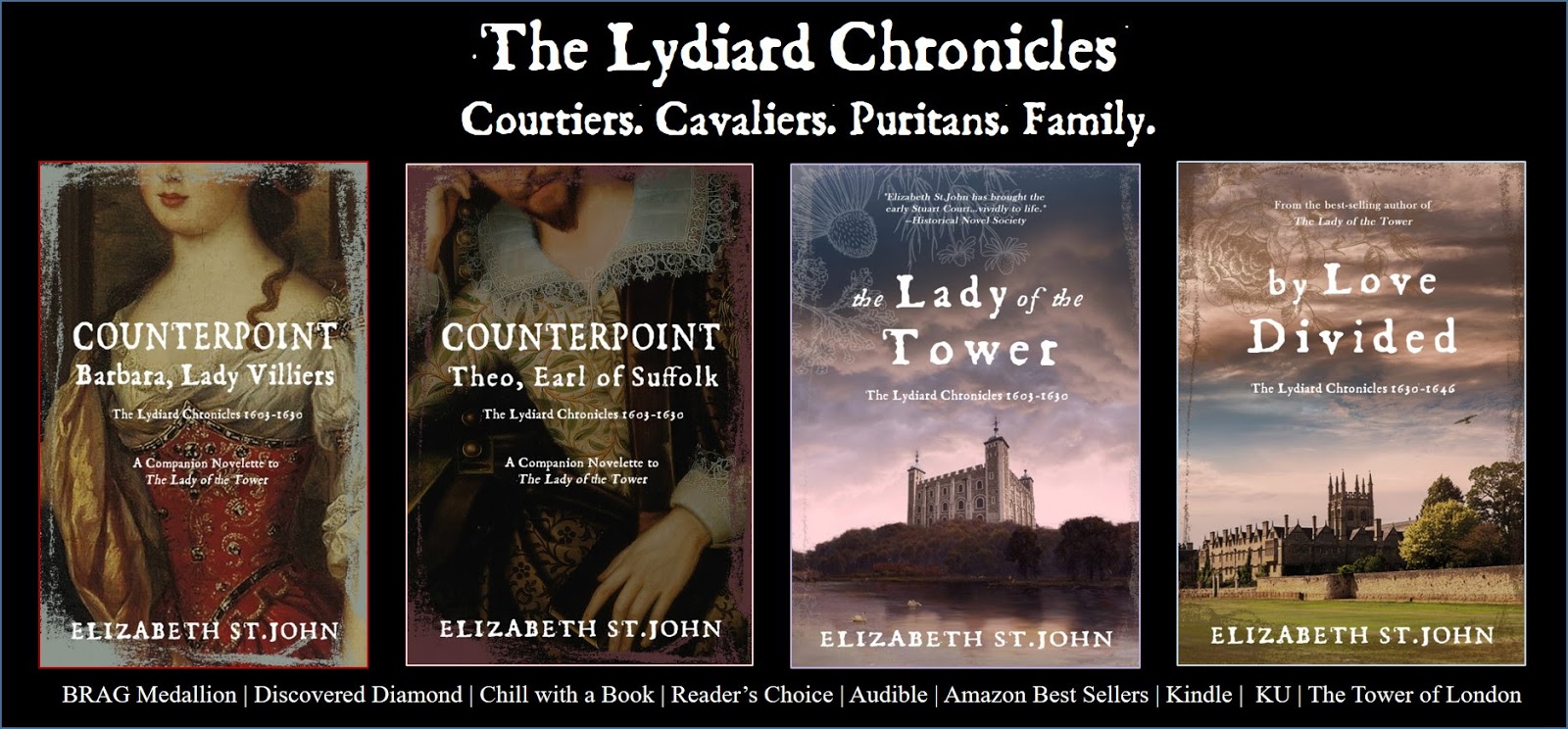
I was privileged and delighted to receive an advance review copy of the latest book by Elizabeth St. John
London, 1649. Horrified eyewitnesses to King Charles’s bloody execution, Royalists Nan Wilmot and Frances Apsley plot to return the king’s exiled son to England’s throne, while their radical cousin Luce, the wife of king-killer John Hutchinson, rejoices in the new republic’s triumph. Nan exploits her high-ranking position as Countess of Rochester to manipulate England’s great divide, flouting Cromwell and establishing a Royalist spy network; while Frances and her husband Allen join the destitute prince in Paris’s Louvre Palace to support his restoration. As the women work from the shadows to topple Cromwell’s regime, their husbands fight openly for the throne on England’s bloody battlefields.
But will the return of the king be a victory, or destroy them all? Separated by loyalty and bound by love, Luce, Nan and Frances hold the fate of England—and their family—in their hands.
A true story based on surviving memoirs of Elizabeth St.John's family, Written in their Stars is the third novel in the Lydiard Chronicles series.
This is, as the blurb says, the third in the Lydiard Chronicles and one thing I would say at the outset is that ideally readers should acquaint themselves with this family by reading the first two in the series. Reading this book as a standalone is perfectly possible, as Ms St. John makes it clear who everyone is, and offers appropriate backstory where necessary. But to skip the first two books is to miss the nuance, and the development of the characters who now play out the final part of this rich and detailed story.
At the centre of this story is the divided loyalties of a family torn apart by civil war, the continuing struggle for peace and resolution of all conflict, political and personal. This is not so easy for, as one character says, "The war has not ended, not while the king breathes and hope beats in men’s hearts.”
Luce, Nan and Frances have different experiences of life, love, and war, yet they are bound together, and not just by their family connections. They are women who find a way to live through such historic times, and to protect what is dear to them. Sometimes this sees them working together, and sometimes it throws them into conflict. And this is a perfect time for me now to talk about the author's skills.
There is a section of the book where Frances has reason to turn against Nan and the drama works brilliantly because Ms St. John allows only us, the reader, to know the truth.
She is also a master of scene-setting, so that we can see the characters in action and in context. She never forgets who else is in the room and allows for interaction. I particularly liked the distracting chatter at the moment Frances is put at odds with Nan, and when Barbary Villiers is being spoken to by Nan but is constantly trying to look over Nan's shoulder to try to attract the attention of the king. Such little touches bring the tableaux to life.
We aren't just reading about these people, we can see them. We watch the scenes unfolding. The characters so inhabit their world that it's exactly as we assume it was. Yes, this is how 17th-century people moved, spoke, felt. Nothing is anachronistic, nothing jars or jolts us back to the present.
And the author achieves this in a way that makes it look effortless. She has an economy of phrase and yet manages to drop the reader right into the 17th-century world. The dialogue is realistic and appropriate. While the politics direct the wider stage, the story remains personal. We really feel for this family riven by war and divided loyalties.
The book is evidently well-researched. The author knows her history but her characters know it too and there is no clumsy exposition. Everything just flows. It would have been easy for Ms St. John to dump a lot of information (she is a direct descendant of the family) and to let the documented history speak for itself, yet whilst we are reading about people who actually lived, we are also reading about characters who have been brought to life by the authors's research, imagination, and creative pen. Had these all been purely fictional characters, they would still have felt real.
On a side note, since I'm talking about real history, there was a moment in the book where I thought, 'Did that really happen? If it's true, it is shocking and appalling.' And yes, sadly, it is; a terrible and stark reminder of the dangers these people faced. When it is pointed out that two characters speak of “Old history in these times, sir,” the reply comes, “And yet memories are long.”
And just when we think all will be well come the restoration, the reality hits. Not everyone will be forgiven (particularly the king-killers). Perhaps it is naive to hope for a happy ending? The outcome, though, is not a foregone conclusion and the drama and tension continue to the very end. In some ways, hidebound by the historical fact, the author cannot offer a happy-ever-after resolution and yet, here at the end of this remarkable trilogy, the ends of the threads are tied up beautifully.
Of course, along the way, and again sticking to the known facts, Ms St. John must deliver some bad news from time to time. No spoilers, but again, with a breath-taking economy of words, she made me cry.
You can find the book:
Kobo, Apple, Nook: https://books2read.com/u/mZBDw5
Amazon: https://geni.us/MyBookWITS
New Release: Queen Anna by Tony Riches
Author Tony Riches has a new release... A crown won in the eye of a storm. A queen who refuses to be broken... Princess Anna of Denmark s...
Showing posts with label Lucy Hutchinson. Show all posts
Monday, 25 November 2019
Friday, 30 November 2018
Review/Interview: Elizabeth St John, author of the Lydiard Chronicles
For those who don't know, the Lydiard Chronicles are set in the seventeenth century and concern the real life St John family, who were related to the powerful Villiers family, pivotal players at court. These are stories about real people, some of whom just happen to be the ancestors of the author. I write about much earlier times but, having studied it almost as much as the Anglo-Saxons right through to degree level, I have a deep and abiding love for the seventeenth century and enjoy reading books set in this period.
I read Books 1 and 2 - The Lady of the Tower and By Love Divided - in quick succession and decided to wait until I'd finished Book 2 before reviewing. Why? Because I read in Kindle format, and after I'd finished Book 1 I was able to read the first few pages of Book 2 and got stuck straight in!
First impressions: I'll start with the one very tiny negative. It's a personal choice, but I'm not a huge fan of books written in the first person. That's just me. I wasn't sure whether the personality of the main character would shine through but I stuck with it and I'm so glad that I did. Lucy finds her voice, her strength of character, developing all the time as she grows from girl to adult. I won't give any of the plot away, but by the time she became the Lady of the Tower, I was fully invested in her life, willing some happiness for her. (Does it come for her? You'll have to read to find out!) This is why, by the end of Book 1, I wanted to move immediately on to Book 2. By Love Divided is written in the third person, and while Lucy is still very much in the centre of things, the younger generation now also comes to the forefront. The family relationships, in all their complexity, continue to drive the plot and the characters are very well drawn indeed. Initially I wasn't sure about Barbara Villiers - could anyone be so nasty to her sister and still become a fully-drawn character? Yes, they can. And she does.
As I said, no plot spoilers. But here's a list of what's fabulous about these books: a deft sketching of time and place; the sights, sounds, smells and ways of seventeenth-century England provide an accurate backdrop to the action which brings the scenes alive. The machinations of the court and the people who thrived on such a life are depicted in all their - sordid - brilliance. The reiteration that happiness so often depended on royal favour, that middle- to high-ranking men could lose their livelihoods assisting the king and that widows were vulnerable, and not just financially. Another aspect of life shown vividly here is how often during this period, families were divided, by religion, politics, or both.
The added interest for me, especially being a writer myself, was that these novels are based not only on real people, but the ancestors of the author. I had to know more, so I got in touch with Elizabeth and asked if she'd mind answering a few questions:
AW: I know that the Lydiard Chronicles tell the story of your ancestors, but how did you come to find out about them initially?
EStJ: I grew up as an only child on the North Sea coast; during the winters, when the east wind blew in from Siberia, the casing on our old grandfather clock would open by itself, and my mother would look up from her embroidery and exclaim “here comes Uncle Brian again”. Surrounded by old family furniture, dusty letters and diaries, and flyleaf-inscribed books, the ghosts of dead relatives were far more interesting than those who were living, and I immersed myself in our family history.
My Sundays were usually spent “St.John-hunting” which usually involved traipsing around overgrown churchyards in the pouring rain, clambering over ruined castles and ancient monuments, and drinking luke-warm tea from thermos flasks. Our family tree was well-researched, and the one remaining family seat of Lydiard Park contained portraits going back to Elizabethan times. However, no-one in our family had known the story of Lucy St.John—The Lady of the Tower—and when I discovered the Memoirs in Nottingham Castle’s file cabinet, I was overjoyed. Here was the story for the book I’d always wanted to write.
AW: How wonderful to not only discover famous ancestors, but find their antics worthy of a series of novels! How much sympathy, if any, do you have for Barbara? How did you set about writing her character without making her a caricature? [pictured below: Lucy (left) & Barbara]
EStJ: I actually thought Barbara a fascinating character, and she only emerged as the main antagonist as I constructed the final plot of the book. The Memoirs describe Aunt Joan by name as being “more wicked than the tales of a stepmother”, while Lucy’s sisters were generally described as envious at her beauty. As I researched Barbara’s life, I realized that she was a very clever woman, who managed to hang on to her wealth, property and patronage after her husband’s death and the assassination of her brother-in-law, the Duke of Buckingham. She married her children into extremely influential families, and of course, her granddaughter was Barbara Villiers, Lady Castlemaine, mistress to Charles II. She knew exactly what she was doing.
I feel a great deal of responsibility to all my characters to try to write them as the real people they were, not two-dimensional caricatures. With Barbara, I wanted enough sting in her to create tension throughout the books, but still for readers to have a grudging admiration for her ability to maneuver through the perilous world of Stuart politics. Knowing the full extent of her life through the research, enabled me to write her exploits with empathy.
AW: She certainly comes across as a 'player' but also one who is at one with her choices. How familiar were you with this time period before you began researching the characters?
EStJ: I knew almost nothing about this time period, having had much more interest in Medieval and Tudor England. It was actually with a heavy heart that I started researching and writing, for as a result of our typical English education, I thought this period and the Civil War was about the most boring period of history imaginable. But, as I started to read more deeply the letters, court documents and memoirs themselves, I began to be fascinated by the incredible shift in society and politics that occurred during this time.
Along with primary sources such as Pepys and Evelyn, there were many modern biographies and non-fiction books I read that absolutely brought this home and once I was able to get a feel for the people, I realized that contextually they were all trying to survive a very uncertain world. Interestingly, I wrote The Lady of the Tower during the great recession of 2011-12, and By Love Divided during the run up to Brexit and the US Elections. Both drove home to me that the central themes of corruption and abuse of power haven’t changed much in four hundred years.
A few books I really enjoyed that made this time period really accessible:
The Weaker Vessel – Antonia Fraser
Buckingham: The Life and Political Career of George Villiers – Roger Lockyer
Shakespeare’s Restless World – Neal McGregor
The White King – Leanda de Lisle
The Killers of the King – Charles Spencer
And the original source for my novels:
Memoirs of the Life of Colonel Hutchinson – Lucy Hutchinson
AW: The research has certainly paid off - I felt that the seventeenth-century world was beautifully portrayed. I believe you are currently hard at work with Book 3. How far do you envisage taking the series?
EStJ: Book 3 is well underway, and as a first draft, I have a beginning, middle and end. Hoorah! You have to write that way with biographical historical fiction. This book is intended to complete the stories on this generation of the family – Lucy, Allen and Luce. However, a few new family members have decided to join the party (such as Barbara Villiers, Lady Castlemaine, and John Wilmot, Earl of Rochester), and they may decide to be the basis for another book. I took my inspiration on “Chronicles” as a title from Narnia – the stories don’t all have to be sequential, and people can come and go. I’ll just keep writing for the love of it. Who knows – maybe the medieval St.Johns will come clamoring next!
I asked Elizabeth if she could send me a picture of the magnificent Lydiard House, and here it is, in all its glory:
Connect with Elizabeth on her website: www.elizabethjstjohn.com
and on Facebook: www.facebook.com/ElizabethJStJohn
I read Books 1 and 2 - The Lady of the Tower and By Love Divided - in quick succession and decided to wait until I'd finished Book 2 before reviewing. Why? Because I read in Kindle format, and after I'd finished Book 1 I was able to read the first few pages of Book 2 and got stuck straight in!
First impressions: I'll start with the one very tiny negative. It's a personal choice, but I'm not a huge fan of books written in the first person. That's just me. I wasn't sure whether the personality of the main character would shine through but I stuck with it and I'm so glad that I did. Lucy finds her voice, her strength of character, developing all the time as she grows from girl to adult. I won't give any of the plot away, but by the time she became the Lady of the Tower, I was fully invested in her life, willing some happiness for her. (Does it come for her? You'll have to read to find out!) This is why, by the end of Book 1, I wanted to move immediately on to Book 2. By Love Divided is written in the third person, and while Lucy is still very much in the centre of things, the younger generation now also comes to the forefront. The family relationships, in all their complexity, continue to drive the plot and the characters are very well drawn indeed. Initially I wasn't sure about Barbara Villiers - could anyone be so nasty to her sister and still become a fully-drawn character? Yes, they can. And she does.
As I said, no plot spoilers. But here's a list of what's fabulous about these books: a deft sketching of time and place; the sights, sounds, smells and ways of seventeenth-century England provide an accurate backdrop to the action which brings the scenes alive. The machinations of the court and the people who thrived on such a life are depicted in all their - sordid - brilliance. The reiteration that happiness so often depended on royal favour, that middle- to high-ranking men could lose their livelihoods assisting the king and that widows were vulnerable, and not just financially. Another aspect of life shown vividly here is how often during this period, families were divided, by religion, politics, or both.
The added interest for me, especially being a writer myself, was that these novels are based not only on real people, but the ancestors of the author. I had to know more, so I got in touch with Elizabeth and asked if she'd mind answering a few questions:
AW: I know that the Lydiard Chronicles tell the story of your ancestors, but how did you come to find out about them initially?
EStJ: I grew up as an only child on the North Sea coast; during the winters, when the east wind blew in from Siberia, the casing on our old grandfather clock would open by itself, and my mother would look up from her embroidery and exclaim “here comes Uncle Brian again”. Surrounded by old family furniture, dusty letters and diaries, and flyleaf-inscribed books, the ghosts of dead relatives were far more interesting than those who were living, and I immersed myself in our family history.
My Sundays were usually spent “St.John-hunting” which usually involved traipsing around overgrown churchyards in the pouring rain, clambering over ruined castles and ancient monuments, and drinking luke-warm tea from thermos flasks. Our family tree was well-researched, and the one remaining family seat of Lydiard Park contained portraits going back to Elizabethan times. However, no-one in our family had known the story of Lucy St.John—The Lady of the Tower—and when I discovered the Memoirs in Nottingham Castle’s file cabinet, I was overjoyed. Here was the story for the book I’d always wanted to write.
AW: How wonderful to not only discover famous ancestors, but find their antics worthy of a series of novels! How much sympathy, if any, do you have for Barbara? How did you set about writing her character without making her a caricature? [pictured below: Lucy (left) & Barbara]
EStJ: I actually thought Barbara a fascinating character, and she only emerged as the main antagonist as I constructed the final plot of the book. The Memoirs describe Aunt Joan by name as being “more wicked than the tales of a stepmother”, while Lucy’s sisters were generally described as envious at her beauty. As I researched Barbara’s life, I realized that she was a very clever woman, who managed to hang on to her wealth, property and patronage after her husband’s death and the assassination of her brother-in-law, the Duke of Buckingham. She married her children into extremely influential families, and of course, her granddaughter was Barbara Villiers, Lady Castlemaine, mistress to Charles II. She knew exactly what she was doing.
I feel a great deal of responsibility to all my characters to try to write them as the real people they were, not two-dimensional caricatures. With Barbara, I wanted enough sting in her to create tension throughout the books, but still for readers to have a grudging admiration for her ability to maneuver through the perilous world of Stuart politics. Knowing the full extent of her life through the research, enabled me to write her exploits with empathy.
EStJ: I knew almost nothing about this time period, having had much more interest in Medieval and Tudor England. It was actually with a heavy heart that I started researching and writing, for as a result of our typical English education, I thought this period and the Civil War was about the most boring period of history imaginable. But, as I started to read more deeply the letters, court documents and memoirs themselves, I began to be fascinated by the incredible shift in society and politics that occurred during this time.
Along with primary sources such as Pepys and Evelyn, there were many modern biographies and non-fiction books I read that absolutely brought this home and once I was able to get a feel for the people, I realized that contextually they were all trying to survive a very uncertain world. Interestingly, I wrote The Lady of the Tower during the great recession of 2011-12, and By Love Divided during the run up to Brexit and the US Elections. Both drove home to me that the central themes of corruption and abuse of power haven’t changed much in four hundred years.
A few books I really enjoyed that made this time period really accessible:
The Weaker Vessel – Antonia Fraser
Buckingham: The Life and Political Career of George Villiers – Roger Lockyer
Shakespeare’s Restless World – Neal McGregor
The White King – Leanda de Lisle
The Killers of the King – Charles Spencer
![]() |
| Lucy Apsley Hutchinson's signature |
And the original source for my novels:
Memoirs of the Life of Colonel Hutchinson – Lucy Hutchinson
AW: The research has certainly paid off - I felt that the seventeenth-century world was beautifully portrayed. I believe you are currently hard at work with Book 3. How far do you envisage taking the series?
EStJ: Book 3 is well underway, and as a first draft, I have a beginning, middle and end. Hoorah! You have to write that way with biographical historical fiction. This book is intended to complete the stories on this generation of the family – Lucy, Allen and Luce. However, a few new family members have decided to join the party (such as Barbara Villiers, Lady Castlemaine, and John Wilmot, Earl of Rochester), and they may decide to be the basis for another book. I took my inspiration on “Chronicles” as a title from Narnia – the stories don’t all have to be sequential, and people can come and go. I’ll just keep writing for the love of it. Who knows – maybe the medieval St.Johns will come clamoring next!
I asked Elizabeth if she could send me a picture of the magnificent Lydiard House, and here it is, in all its glory:
Connect with Elizabeth on her website: www.elizabethjstjohn.com
and on Facebook: www.facebook.com/ElizabethJStJohn
Subscribe to:
Posts (Atom)
-
What an ingenious concept: to examine the lives of and the roles played by the women related to the more familiar, male, characters involved...
-
Today is traditionally 'Labour Day' in the UK. I asked 11 other authors to introduce one of their characters and their occupation....
-
So, you've written your book. You've published your book. And, unless you are one of what must be a very rare breed, you are now fli...