Wayne Turmel - New Release The Deserter Q&A

Today, January 15 2026, my author colleague Wayne Turmel releases releases his seventh novel (fourth  historical) The Deserter - a Tale of t...

Showing posts with label Charles Brandon. Show all posts

Wednesday, 23 June 2021

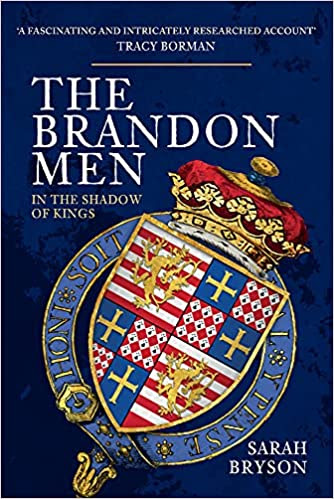
Review: The Brandon Men - Sarah Bryson


Sarah Bryson's new book, The Brandon Men: In the Shadow of Kings, has an interesting title. I knew, or thought I knew, about Charles Brandon, Duke of Suffolk. So who were the others?

Of course, when one stops to think, Charles Brandon didn't appear from nowhere. As the blurb for this excellent new book says:

Four generations of Brandon men lived and served six English kings, the most famous being Charles Brandon, Duke of Suffolk, best friend and brother-in-law to King Henry VIII. Yet his family had a long history tied closely to the kings of the Wars of the Roses back to Henry VI. Charles Brandon’s father, Sir William Brandon, supported Henry Tudor’s claim on the throne and became his standard bearer, dying at the Battle of Bosworth. Charles’s uncle, Sir Thomas Brandon, was Henry VII’s Master of the Horse, one of the three highest positions within the court. Charles’s grandfather had ties with Henry VI, Edward IV and Richard III. These men held important offices, made great sacrifices, walked the fine line between being loyal courtiers and traitors, and even gave their lives, all in the name of loyalty to the king they served. No more shall the Brandon name be an obscure reference in archives. It is time for them to emerge from the shadows of history.

The author explains at the outset that of the earlier Brandon men, there is less in the way of historical record, but she makes the most of what is available, detailing as vividly as possible the careers of the men who brought the family up from rather humble beginnings to the highpoint at which Charles Brandon became Henry VIII's trusted friend.

What is evident is that this was far from a foregone conclusion. As Ms Bryson points out, Sir William Brandon II was the only member of the nobility on Henry Tudor's side to be killed at Bosworth. This left his wife, and her son Charles, then only one, in somewhat of a precarious position.

However, Charles Brandon thrived and, inevitably, most of the book's pages are taken up with his story. Some of it, such as his treasonous marriage to Henry VIII's sister, I knew, but this very readable book gives the background to that, tells us about Charles' earlier and subsequent marriages, and explains, wherever possible, what happened to the various Brandon women, too.

There is also extensive detail about his dealings in East Anglia, his diplomatic missions and military enterprises, and what comes across is a real sense of his character. Whilst reading, I felt I was really getting to know the man.

It's easy, I suppose, to assume that Charles was just another rich playboy at the young Henry VIII's court and this simply isn't the case. His family had risen through loyal service and Charles fared better than many of Henry's friends for, as the author points out, he knew Henry the man, as well as Henry the king. He wasn't universally liked, but he kept his head, and the friendship of the king where others failed in both those respects.

It is astonishing that a family could rise to such lofty heights in relatively few generations, and sobering that it all fell away so quickly, too.

Ms Bryson has a very engaging style, and the book, whilst being packed with historical detail and lengthy quotations from primary source documents, is also an easy and enjoyable read.

Highly recommended.

[Thank you to Amberley Books for providing me with an advance copy, with no obligation to review.]


The book is available from:

Amberley Books

Amazon 


Monday, 13 January 2020

Interview: Author Tony Riches

I've recently been thinking about why the Tudors remain so popular and I've come to the conclusion that it's simply because this period was like no other. A queen was succeeded by yet another queen, and a king executed two of his wives. Even without the break from Rome, this is all unprecedented stuff. However, away from the main players at court, there are still stories to be found and my guest today, Tony Riches, seems to have a knack of finding them.


AW: Welcome to the blog, Tony. Your Tudor Trilogy focuses on the early years, and those men who founded the dynasty. There is a certain 'romance' in the stories of Owen and Jasper Tudor, but do you find Henry VII a sympathetic character?

TR: Like Henry Tudor, I was born in the Welsh town of Pembroke, a connection which inspired my fascination with the Tudor dynasty. As part of my research I followed in Henry’s footsteps from
Fortresse de Largoet, Brittany
Pembroke to the exile in remote Brittany, then back to Mill Bay and on to the battle at Bosworth. (See my blog for details.) 


Statue of Henry VII at Pembroke Castle

This journey gave me a real sense of Henry’s early life and helped me take a fresh look at how he has been portrayed through the centuries. Far from being miserly, he spent a fortune on good living – although he never recovered from the death of his son Arthur, followed by the loss of his wife, Elizabeth of York.


This helped me understand his strange treatment of his remaining son and heir, and how Henry VIII turned out as he did. Henry VII’s legacy was that he ended what have become known as the Wars of the Roses, and secured peace with France and Spain, and should be remembered as a man who tried his best to be a good King of England.   

AW: You then took your novels in a slightly different direction and examined, in the Brandon Trilogy, the life of Henry VIII's sister, Mary, perhaps a less well-known member of that illustrious family. What drew you to her story?

Each of my books moved on one generation, so Mary Tudor’s story provided a perfect ‘sequel’ to my Tudor trilogy. I never understood why the television series The Tudors ‘merged’ Mary with her sister Margaret, when her story is so intriguing. I wanted to explore what it must have been like for Mary to become Queen of France, then to defy her brother and marry for love.


During my research I visited Mary’s home at Westhorpe and her tomb in Bury St Edmunds, where I saw a lock of her hair in the nearby museum. It was amazing to feel so close to her after studying every detail of her life for two years. 

AW: I bet it was. I love these tangible links to the past. 

AW: Charles Brandon - romantic hero? 

TR: Brandon was a chancer, always in debt and prepared to take great risks for advancement. I tried to show how the social standards of his time shaped his decisions. I believe he loved Mary Tudor, and struggled with his conscience during the downfall of Catherine of Aragon and the trial of Anne Boleyn.

His surviving letters reveal his loyalty and sometimes naivety. When Brandon died, Henry VIII said that in all their long friendship Charles Brandon had never knowingly betrayed a friend or taken advantage of an enemy. He is reported to have asked his council, ‘Is there any of you who can say as much?’   

AW: Admirable, but also, as you say, maybe naive. Your latest novel tells the story of Brandon's last wife, Katherine Willoughby. How easy was it to research her life; was it as well-documented as some of the other Tudor characters?

Katherine Willoughby was a complex and surprisingly modern woman, far ahead of her time. I started with the big question of how the daughter of a devout Catholic, Maria de Salinas, became a radical Protestant, which led me to explore her friendship with men like Hugh Latimer and William Cecil, as well as women like Anne Askew and Catherine Parr.

When I began my research, I had no idea that she knew every one of Henry VIII’s wives, as well as his daughters, Mary and Elizabeth, and his son Edward. Her letters and the details of her exile when Mary became queen show real strength of character, and her story provided me with the perfect way to conclude the stories of the early Tudors.

AW: I suppose it must be remembered that Henry got through his last five wives quite quickly, but it's still a shock to hear of someone who knew them all. Would you consider writing any novels centred around Henry VIII himself and/or his wives, or do you prefer to write about those who lived their lives slightly away from centre-stage?

TR: I’ve enjoyed building a picture of Henry VIII as seen through the eyes of those who knew him, and am now doing the same with Elizabeth I in my new Elizabethan series. I think it would be quite a challenge to find a way of telling Henry’s story with much sympathy.

AW: I tend to agree! To move away from the Tudor period, if I may, one of your earlier novels is set in tenth-century Wales. Any plans to return to that time period with your writing?

TR: My book Queen Sacrifice was my first attempt at historical fiction and an interesting exercise, as the narrative follows every move in the famous queen sacrifice chess game. I have at least three more books to write about the Elizabethans, but there are plenty of fascinating stories from Welsh history I  would like to return to one day.

AW: Thanks so  much for chatting about your books Tony.


About the Author

Tony Riches is a full time author of best-selling fiction and non-fiction books. He lives by the sea in Pembrokeshire, West Wales, UK, with his wife and enjoys sailing in his spare time. For more information about Tony’s books, podcasts and audiobooks please visit his website www.tonyriches.com and find him on Facebook and Twitter