New Release: Queen Anna by Tony Riches

  Author Tony Riches has a new release... A crown won in the eye of a storm. A queen who refuses to be broken... Princess Anna of Denmark s...

Showing posts with label Medieval. Show all posts

Monday, 18 April 2022

Guest Post: Amy Maroney, author of Sea of Shadows

 It is my absolute delight to welcome author Amy Maroney back to the blog. Amy's new release is called Sea of Shadows and once again she's taking us to Medieval Rhodes. Over to you, Amy:

~~~~~~~~~~~~~~~~~~~~~~

While we rarely hear about women artists working during the medieval and Renaissance eras, they did exist. Though their work was often made anonymously or attributed to the fathers, brothers, and husbands they worked with, we can sometimes find traces of these women in tax rolls and wills. My new novel, Sea of Shadows, stars Anica Foscolo, a gifted woman artist who is the talent behind the oil portraits and frescoes made by her father’s workshop on the island of Rhodes in Renaissance-era Greece. Anica is fictional, but she was inspired by real women. 

In 13th-14th century Paris, for example, women made up about 10 to 15 percent of all taxed individuals. This number included artisans, widows, business owners—any female earning her own taxable income. Illuminators and embroiderers showed up frequently on the tax rolls, as did silk-weavers, brocaders, and textile finishers. Women were accepted into many trade guilds of the time, usually via family members, but some trades had free entry and accepted all who met their requirements. 

Medieval Woman Painting a Woman, by
Giovanni Boccaccio, French National Library

These women mostly worked in obscurity, but there are some examples of women who worked in family art studios and became renowned painters in their own right. Golden Age artist Artemisia Gentileschi is probably the biggest star among them. Her father taught her to paint. She went on to establish her own art studio, securing commissions by wealthy merchants and nobles during her 17th-century career. 

My first historical fiction series, the story of a Renaissance-era female artist and the modern day scholar on her trail, featured a fictional woman painter named Miramonde de Oto. She was based on the real artist Caterina van Hemessen, who worked with her father in his Flanders studio, churning out portraits of wealthy patrons as well as a mesmerizing self-portrait, which she signed. 

Caterina Van Hemessen, Public Domain Image

One of my favorite artists of the Early Modern era is Clara Peeters, master of the still-life painting. She often hid her name or self-portrait within her paintings, which is a trick my fictional artists deploy as well. I love the idea of women artists claiming their work in sly ways, sending a message to viewers decades or centuries in the future. How many more of them are waiting to be found?

Clare Peeters, Self-portrait, Pubic Domain Image

It’s a question that haunts me. I was thrilled to learn recently of a female artist, Agnes van den Bossche, who was a member of the Ghent, Flanders, artists’ guild for over three decades during the 15th century. Her father and brother were master painters. For her part, Agnes painted mostly on cloth. Her only known surviving work is a banner she was commissioned to produce for the city of Ghent. 

The Banner, Image: Wikimedia Commons

Agnes is that rare person—a woman artist of the late medieval/early Renaissance era whose story survives. Most of her contemporaries are lost to history, their voices and legacies relegated to the shadows. As a writer who specializes in stories about forgotten women artists, I hold up Agnes as evidence that the artists I create in my fiction are based on real women, not just my imagination. 

With my new Sea and Stone Chronicles series, I wanted to focus on unsung, unknown women like Agnes van den Bossche. For every Agnes we can point to in the historical record, there must be hundreds who are lost to history. Women who had every bit as much talent as their male counterparts–and, in some cases, more—but were never acknowledged. 

Sea of Shadows, the second book in this series of stand-alone romantic historical suspense novels, stars an unlikely duo. Anica Foscolo, a gifted painter on the Greek island of Rhodes, is the daughter of a Venetian artist and a Greek woman. Drummond Fordun is a fierce Scotsman renowned for his exploits as a privateer serving the Knights Hospitaller of St. John, who are headquartered on Rhodes. When her family’s honor is threatened, Anica reluctantly turns to Drummond for help. There’s just one problem: she never planned to fall in love with her accomplice.  

Like Island of Gold, its predecessor in the Sea and Stone Chronicles, Sea of Shadows explores the shadowy world of the Mediterranean during a time of adventure, war, prosperity, and risk. 

The Colossus of Rhodes - Public Domain Image

Artists and artisans exploited the wealth in Rhodes Town under the rule of the Knights Hospitaller, setting up studios and workshops within the walled city. Gold-beaters, jewelers, textile workers, stoneworkers, and painters were among the creative classes. Italian-trained artists were commissioned by the knights to create frescoes and paintings for their private residences and for chapels and churches on the island. At the same time, the astounding layers of history in Rhodes offered opportunities for entrepreneurs to sell artifacts to collectors from Italy, who traveled to the island seeking treasures for wealthy patrons.

My heroine Anica Foscolo, the unsung talent behind her father’s dazzling portraits, is a product of her environment, and as such she embodies the conflicting loyalties of her time and place. She’s Venetian (not always an advantage for a citizen living under the rule of the Genoa-loving Knights Hospitaller), but she’s also Greek (and, as such, seen as subservient by the Knights Hospitaller).

Rhodes under the rule of the knights was a goldmine of adventure, scandal, love, and divided loyalties, offering rich fodder for a historical novelist. Though I never found evidence of a woman artist working in Rhodes at the time, there was plenty of evidence about male artists who prospered there. So I created Anica in homage to women working in family studios who never made it into the historical record. She gives a voice to the silenced stories of the past—and serves as a reminder that the historical record is full of holes just waiting to be filled.
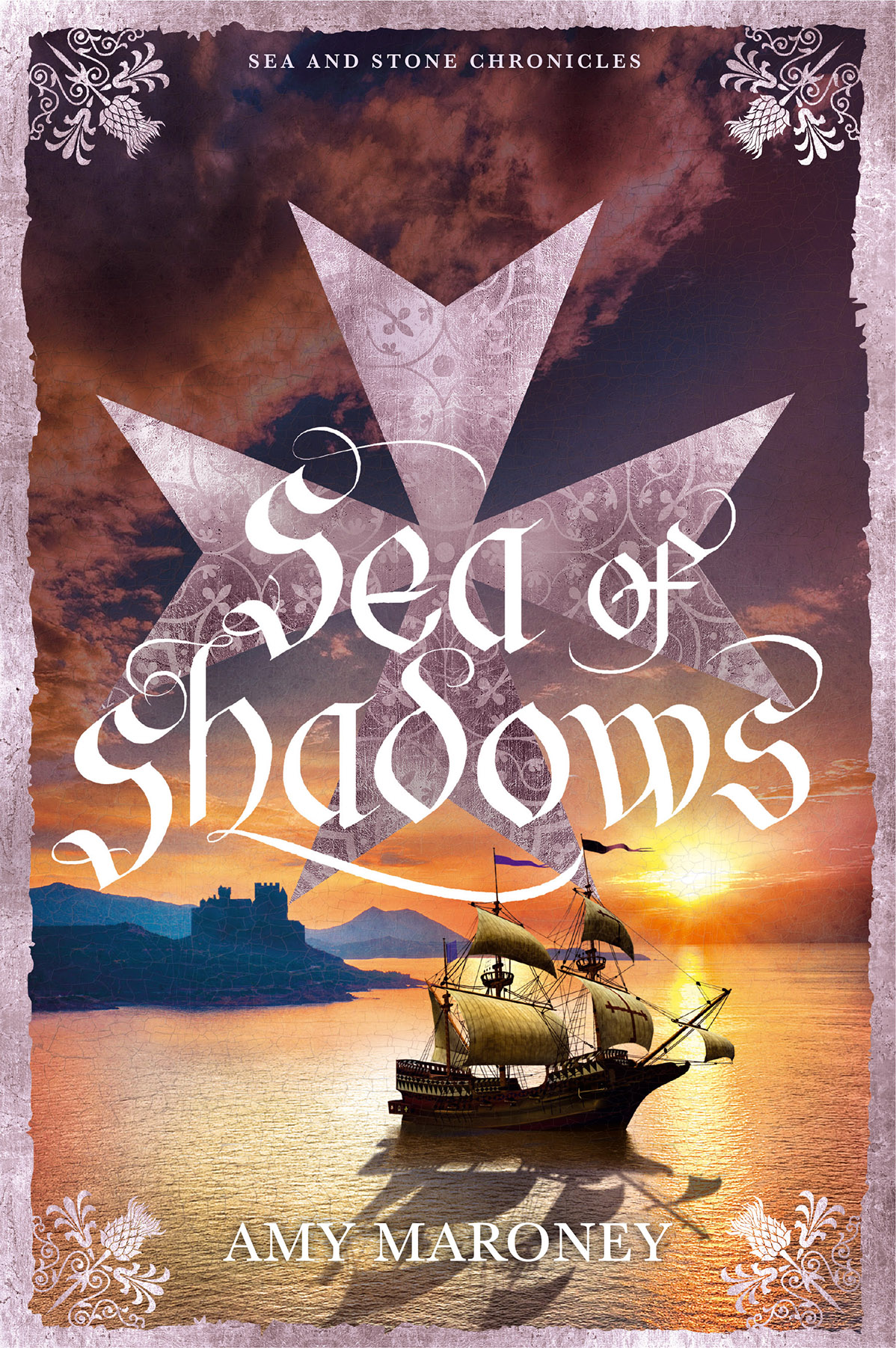
Sea of Shadows 

1459. A gifted woman artist. A ruthless Scottish privateer. And an audacious plan that throws them together—with dangerous consequences. 

No one on the Greek island of Rhodes suspects Anica is responsible for her Venetian father’s exquisite portraits, least of all her wealthy fiancé. But her father’s vision is failing, and with every passing day it’s more difficult to conceal the truth. 

When their secret is discovered by a powerful knight of the Order of St. John, Anica must act quickly to salvage her father’s honor and her own future. Desperate, she enlists the help of a fierce Scottish privateer named Drummond. Together, they craft a daring plan to restore her father’s sight. 

There’s only one problem—she never imagined falling in love with her accomplice.

Universal Amazon link

Amazon UK

Amazon US

Amazon CA

Amazon AU

About the author:

Amy Maroney studied English Literature at Boston University and worked for many years as a writer and editor of nonfiction. She lives in Oregon, U.S.A. with her family. When she’s not diving down research rabbit holes, she enjoys hiking, dancing, traveling, and reading. Amy is the author of The Miramonde Series, an award-winning historical fiction trilogy about a Renaissance-era female artist and the modern-day scholar on her trail. Her new historical suspense/romance series, Sea and Stone Chronicles, is set in medieval Rhodes and Cyprus.

Social Media Links:

Website

Twitter

Facebook

Instagram

Pinterest

Book Bub

Amazon Author Page

Goodreads


Friday, 23 August 2019

Review: Blossom on the Thorn by Loretta Livingstone

1195
"I should have had nothing to do with those accursed Angevins. I should have run like hell in the opposite direction."

Giles de Soutenay can scarcely be blamed for his disappointment. Promised an heiress by Queen Eleanor, he is dismayed to discover that, although young and attractive, his bride has all the warmth of a stone effigy.

For the newly widowed Isabella, the reality of a new husband is no cause for celebration. She will do her duty but no more. She will give de Soutenay no reason to complain but he will not have her heart, for any belief in love and tenderness died during those brief years of her first marriage. However, she has reckoned without Giles' perseverance.

After the snows of winter, spring brings hope, until the arrival of a stranger threatens Giles and Isabella’s blossoming happiness. A stranger who might tear them apart before they have truly found each other. Only if Giles can learn patience and Isabella can learn trust can they hope to find lasting love.


So runs the blurb for this, the third in Loretta Livingstone's Out of Time series. The first two books are 'time-slip' novels but this third is not (apart from one brief mention of a 21st-century character in the abbey). I read this as a standalone, but it's as well to know that the other books are time-slips, otherwise that scene in the abbey might prove something of a shock!

But, that said, all the other characters are from the twelfth century and behave as such. By which I mean that Ms Livingstone has clearly done first class and painstaking research. I was never once jolted out of the medieval world and each scene was beautifully and accurately depicted. The hall of Giles and Isabella teems with medieval servants going about their medieval chores, and all are clothed according to the fashions of the day. Isabella is very much a woman of her time. She has guts, and fortitude, but nevertheless she is a medieval lady, not a modern woman, and her reaction to what happens to her never strays beyond the limits of the options available to a woman of her rank during that period. 

Giles is a bit of an anomaly. He's certainly a surprise to Isabella; I wondered at times whether his attitudes have been shaped by his coming into contact with modern-day characters in the other books? I guess I'll have to read them to find out! When he exacts revenge though, he is every inch the medieval soldier. So once again we have drama, but that which sits perfectly in its period setting.

There are plot twists and turns, despicable acts, and characters who left me itching to watch them get their comeuppance. At the heart of this story though is the romance between the two characters and it's a satisfying story arc which sees them struggle with initial wariness, disagreements, misunderstandings and the efforts of others to thwart them and drive a wedge between them. 

I enjoyed watching Isabella grow and develop, and appreciated the occasional reminders of just how young she is. This of course was not unusual, and it made me stop and think just how much this poor lass has endured by the time she's seventeen.

Ms Livingstone knows the world she's writing about, but uses her research sparingly; she tells us what we need to know but mainly uses her knowledge of the period to paint the scenery. The dialogue flows naturally, and nothing jars.

I especially loved the scene involving the window. Sometimes it's nice to be reminded that people from history were modern-day characters in their own world. I'll say no more, except that it made me smile that Giles and Isabella have a lovely moment of 'keeping up with the Joneses'.

Romantic fiction is perhaps not my usual read, but I have to say that this is a wonderful example of its genre.

Find it on Amazon UK and Amazon US
and find more about Loretta HERE

Tuesday, 29 May 2018

Review: Women in Medieval England by Lynda Telford

I am privileged to have received a pre-publication copy of this wonderful new book by Lynda Telford, a fellow Amberley author.


Perhaps I should start this review by quoting a section of the press-release:

'The author starts by contrasting the differences in status between Anglo-Danish or Saxon women with those who fell under the burden of the feudal system imposed by the Normans. She covers such subjects as marriage and childbirth, the rights an responsibilities of wives, separation and divorce, safety and security and the challenges of widowhood.'

The first chapter drew me in immediately. 'The Loss of Equality' gives an overview of the status and general lot of pre-Conquest women. I spend my life writing and reading about Anglo-Saxon England, so there were few surprises here for me. The chapter provides a good overview, although it is not reign-specific. However, the author makes good use of the law codes, which is where we find most of the information about the rights of women at this time. There is always something new to ponder, and the author makes a particularly good point, and one which I've not heard mooted before, regarding the changes which came about after 1066. She says that the noble widows, forced to marry new Norman overlords, might at least have had a rudimentary understanding of the language - there were many Normans at the court of Edward the Confessor, who had himself spent many years in Normandy - but the 'peasantry' would not have had any grasp at all of the foreign language. How truly terrifying that must have been.

Of course, the main focus of the book is the fate of women after the Normans took control, and the subsequent chapters contain a wealth of information about how women lived and what was expected of them. Nuggets of information include discussions about what exactly constituted marriage, and the fact that it was not uncommon for two women to claim consummation with the same man.

In Chapter Three we learn of rather unusual, but quite logical, methods of contraception and some rather brutal cures for male impotence, including one which might have worked, but resulted in a crop of nettle stings. Ouch!

This is not a 'sensational' book in that sense, however. The horrors of childbirth, while told in unflinching detail, serve only to demonstrate how precarious life was.

The legal status of married women is explored in detail, and we learn how much women were supposed to defer to their husbands, and how much and often their husbands could chastise them. (I had not hitherto known the derivation of the phrase 'rule of thumb'.)

Although this is a general history, looking at the plight and situation of women across the social spectrum, it is liberally peppered with examples of individual stories, and is the richer for it. We also learn some interesting specifics: in 1422, women who sold fish were not allowed to oversee the trading in oysters in London's Queenhithe. We also learn of the opportunities which opened up for survivors of the Black Death.

This is a thoroughly researched book, an easy read, but packed full of information. Some of it familiar, but much of it new, certainly to this reader. As with the first chapter, that information is presented in a thematic way, and not reign-specific. Because I not only read about history, but use books for my own study and research, I would have preferred a little more detail about how life changed for women, not only post-Conquest, but in the subsequent centuries covered in this book.

In that vein, I would also have preferred a little more information in the notes at the back of the book, where only the names of the source books are given, and not the relevant page numbers. For those wishing to pursue further study, this will be frustrating.

All in all, an accessible book which provides masses of detail in an extremely readable way. I'd heartily recommend it to anyone interested in learning more about the role, status and general lot of women in medieval England.