New Release: Queen Anna by Tony Riches

  Author Tony Riches has a new release... A crown won in the eye of a storm. A queen who refuses to be broken... Princess Anna of Denmark s...

Showing posts with label Annie Whitehead. Show all posts

Wednesday, 14 June 2023

Guest Post by Heather Darsie

Today I'm delighted to hand over the blog to a fellow Amberley Books author, Heather Darsie, whose new book, Children of the House of Cleves, Anna and Her Siblings, is out today:


Religion in the House of Cleves

by Heather R. Darsie, J.D.

Ah, religion. That sticky subject at dinner parties! The subject of religion was a very tense one in 16th century Germany. Anna of Cleves’ father Johann III of Cleves-Mark and mother Maria of Jülich-Berg did what they could to uphold Catholicism within the United Duhies in the wake of Martin Luther’s 95 Theses and the reforms it spawned,

“Johann III was against the spread of Lutheranism within the United Duchies. To … stop the spread of Lutheranism, an edict was issued in March 1525. This strategy worked for the most part, and Lutheranism was put down within Jülich-Cleves-Berg. Johann followed-up with an ordinance in July 1525, demonstrating his desire for reform of the Catholic church within his lands. Although Johann wished to remain on [Holy Roman Emperor] Charles V’s good side, he did not wish to aggressively eradicate Lutheranism. This strategy might be evidence of [Desiderius] Erasmus’s influence. It was not that the Catholic church was perfect, but rather that Luther and his followers were dangerous. …

…The same year as her marriage, 1527, Sybylla’[of Cleves’]s father-in-law John the Steadfast established the Evangelical-Lutheran State Church of Saxony after the Diet of Speyer. John was extremely active in establishing the principles of Reformation within Saxony, much to the chagrin of Charles V.”

The oldest and youngest Cleves siblings, Sybylla and Amalia, wound up being devoted to Lutheranism. Amalia was reportedly so faithful to Lutheranism that it was deemed impossible to find her a husband. Anna was Catholic, although how strong her actual faith was is unknown. Wilhelm, for his part, was Catholic when it suited him.

Even more confusingly, Wilhelm’s daughters were raised as Lutherans due to the influence of their aunt Amalia. Wilhelm reportedly flew into rages more than once at Amalia over her vehement support. Despite this rift in the family, Wilhelm had his poetic revenge on Amalia.

Image from Anna's prayer book: Trogen, Kantonsbibliothek Appenzell Ausserrhoden, CM Ms. 9, f. 12r – Gebetbuch der Anna von Kleve.


If this excerpt piqued your interest, consider reading Children of the House of Cleves: Anna and Her Siblings, set for release in the UK on 15 June 2023 and in the US/Internationally on 12 September 2023. Can’t wait until September? The US Kindle version is released on 15 June, too! 

Amazon UK (15th June 2023):

Hardback

Kindle 

Amazon US :

Hardback (12th September 2023)

Kindle (15th June 2023)


You might also like to read Heather R. Darsie’s biography on Anna of Cleves, the first researched and written from the German perspective, Anna, Duchess of Cleves: The King’s Beloved Sister

Amazon UK

Amazon US

[You can read Annie's review of Anna, Duchess of Cleves: The King's beloved Sister HERE]


Heather R. Darsie works as an attorney in the US. Along with her Juris Doctorate she has a BA in German, which was of great value in her research. She completed multiple graduate-level courses in Early Modern History, with her primary focus being the Holy Roman Empire under Charles V. She runs the website MaidensAndManuscripts.com, and is a co-host of Tudors Dynasty podcast.


Sources & Suggested Reading

1. Darsie, Heather R. Children of the House of Cleves: Anna and Her Siblings. Stroud: Amberley (2023).

2. Darsie, Heather R. Anna, Duchess of Cleves: The King’s Beloved Sister. Stroud: Amberley (2019).


Catch the rest of Heather's Blog tour:


Friday, 1 May 2020

Characters and their occupations - 12 authors introduce

Today is traditionally 'Labour Day' in the UK. I asked 11 other authors to introduce one of their characters and their occupation. I hope you take instantly to this varied group and all the buy links are there if you want to read further. (If? Of course you do! 😉)


Pauline Barclay
Hello, I’m Dor, I’ve been asked what my occupation is, my girl says I’m a scrubber, she’s a cheeky mare! Ok, I’m a cleaner and have four jobs that have me rolling my sleeves up! Not glamorous, but it pays the bills, just! One of my cleans is an office, you wouldn’t believe how office folk leave the place, and the little bleeders like their morning joke! I’ll be putting my coat as there’re strolling in. “Lucky you, we’re starting and you’re off to put your feet up.’ I won’t say what I’d like to reply, but with three other places to muck out, it ain't polite! They might all look down their beaks at me, but at the end of the day I was the one who wiped the smile from their faces because sometimes it happens!


The Birthday Card
Web Site
Blog Site
Facebook
Twitter: @paulinembarclay
Instagram @paulinebarclay


Cryssa Bazos
Elizabeth Seton comes from a long line of herbalists and has a talent for the healing arts. Ever since she was a little girl in Weymouth, she planned to follow in her mother’s footsteps and continue to care for the sick who came to their door. Until civil war reared its ugly head and a community was left divided. With her family destroyed, Elizabeth uproots herself to live with her widowed aunt, a healer in her own community. Under the guidance of her aunt, Elizabeth once more explores her art by creating simple syrups, tinctures, salves, and purges. Snakeweed for the ague, willow bark for pain, king’s claver for consumption, and take care not to trod on moonwort lest your horse cast a shoe. The tools of her trade, mortar and pestle, scales and stills, transform herbs and roots into medicine, while her aunt’s receipt book captures generations of experience. 

Traitor’s Knot buy link
Website: https://cryssabazos.com
Twitter (@CryssaBazos)
Facebook


Anna Belfrage
Name: Adam de Guirande, protagonist of In The Shadow of the Storm. Occupation: Knight. Excels at the broadsword, is more than capable with a lance but will admit to being less of an expert with bow and arrow—he has archers to handle such. Recently wed to a lady who is not quite what she seems to be and is finding married life comes with numerous challenges, one of which is having a new person wiggle her way into his heart. Will do anything for his lord and master, Roger Mortimer, which does not necessarily endear him to King Edward II who considers Mortimer a rebel and his greatest enemy. But knights as loyal and honourable as Adam are hard to come by so hanging him may be a waste. Or maybe not—after all, WHO is he loyal to? That perfidious Mortimer or his king? 
Find out more about Anna on her website, check out her Amazon page and connect on FB and Twitter.

Buy In the Shadow of the Storm


Kathryn Gauci 
Sophia Laskaris is a couturier in Constantinople during the last years of the Ottoman Empire. Born into a family of professional embroiderers, she is a woman who is not only creative, but has a head for business too. Her grandmother, Dimitra, one of the first embroiderers to gain the patronage of the Sultan’s family and who took her business to great heights throughout the empire, was the guiding light in her life. Sophia opened up her couture house, La Maison du L’Orient, in Pera, the fashionable European district in the city, at a time when European fashion was becoming popular, but she continued to create designs based on the oriental look and was admired by Parisian designers such as Paul Poiret. She was highly educated, speaking several languages, and politically astute. With the outbreak of the Balkan Wars in 1912 and WWI, she used her work to not only aid Turks in distress, but to gather information for the Greeks who were seeking independence. When the situation deteriorated, she was forced to flee Turkey and reinvent herself as a seamstress in Athens. After the Germans occupied Greece, she drew on her previous background to aid the Resistance.

Buy The Embroiderer 
Website 
Facebook
Twitter
Instagram


Susan Grossey
My narrator Sam Plank’s occupation – that of magistrates’ constable – is central to his life and to my books.  Magistrates’ constables existed for only a short period of policing history: they were used in London during the two decades or so after the Bow Street Runners and before the Metropolitan Police, which was the 1810s and 1820s.  At that time there was little concept of investigation of crime, and none at all of detection.  If you were the victim of a crime and had some idea who had done it, you took your complaint to the local magistrate.  If he thought your claim had merit, he would task one of his constables with executing a warrant to bring the accused in for questioning.  Of course, “my” Sam is much more curious than that and makes a great deal more of his role, taking a particular interest in financial crimes…

Website 
Blog 
I tweet as @ConstablePlank
Monthly Newsletter (for updates & offers) 


Helen Hollick
I was elected King of England in January 1066. It was an honour I did not want, but who else is there able to protect this noble land from those who want to steal our wealth and the Crown for their own?
King Edward died without a son, the only other of royal blood is but a boy with no experience of battle or government. To be King I must ally with the Northern Earls, so I must take their sister to be my Queen. She is a comely lass, but I have a handfasted wife, my beloved Edyth, mother of my children. So, I set her aside for the good of England, for stability and prosperity. Hah! Being King is a privilege you say?  I swear it is not. But I will do my duty and all I can to protect you, my people from the  threatening tyranny of Normandy. Or die trying.

you tube trailer:
Website
Newsletter Subscription
Main Blog
Amazon Author Page 
Twitter: @HelenHollick


Charlene Newcomb 
I thank Mistress Annie from Westminster’s kitchens who invited me here today. I met her when nobles gathered to crown the new king. I was wearing my fancy clothes—stolen, of course—pretending to be a page. Mistress Annie knows I’m a thief living on the streets, sleeping in the eaves of St. Paul’s or here at Westminster many a night, but she doesn’t fault me. She feeds me and my friend now and again, best chicken in garlic and onion sauce served alongside the best gossip. We hear the king, the one called Lionheart, is gathering an army for a pilgrimage to Outremer. Streets of London or camp follower—not much different. Being good with dice, I can win a coin or two. We might pick up some work. I can brush down a palfrey, and Little John is handy with needle and thread. And if we cannot work, there’ll be pockets-a-plenty to pick. 
—meet young Allan and Little John in Men of the Cross


Find Char’s books on Amazon & connect with her on Facebook, Twitter, or Instagram.


Amy Maroney
Artist, healer: Miramonde de Oto was a woman of many skills. Raised in a convent in the medieval Pyrenees, she learned healing remedies from the “mountain folk” and worked during her adolescence in the convent’s infirmary. In her childhood, she used bits of charcoal to draw on the marble step of an old well. When she learned to write, she was tasked with copying and illuminating manuscripts in the convent’s library. Eventually she graduated to painting portraits, thanks to an exceptional art teacher. It wasn’t until catastrophe struck the convent that Miramonde would go on to use her talents in the wider world—and unlike most women artists of her time, she even got paid for it. 

The Girl from Oto is available on Amazon UK and Amazon US
Get a free prequel novella to The Girl from Oto and find Amy’s Blog here. Connect with her on Twitter, Instagram, Pinterest and Facebook


Alison Morton 
Jobs for the girls? Aurelia Mitela has always known she would serve her country in some way; she’s a bone-and-blood Roma Novan, member of a leading family with military commanders, diplomats and councillors among her ancestors. She becomes all three eventually, through AURELIA, NEXUS, INSURRECTIO and RETALIO, but is locked in bitter opposition with her lifelong enemy. Passionate and complex, she will do anything to protect both her daughter and her lover, but despite her innate strength she is crippled by self-doubt.

Soldering requires hard physical and mental training which needs persistence and a love of the life of camaraderie, tough decisions and quick and cool judgement in trying circumstances. In a softer way, so does a diplomat’s life! But being a councillor to a weak ruler requires the toughness of mind and an ability to suppress frustration, something that Aurelia doesn’t always achieve...


Amazon author page  
Buying link
Website
Website link to Aurelia specifically


Elizabeth St John 
Nan Wilmot
aka Anne St.John Lee Wilmot
The Countess of Rochester

Job Title: 
Spymistress to Charles II

Qualifications: 
Ambitious multi-talented outgoing individual with wide-ranging contacts across both Parliamentarian and Royalist departments. Highly skilled in project management, sales, marketing and procurement. Exceptionally discreet, trustworthy and decorous.  Fluent in English and French, with proven communication skills, especially in translations and multi-media. Experienced in multiple coding languages. Good social skills, conversant with inter-departmental protocols and processes and an ability to integrate smoothly within existing teams. Successful problem-solver, works well under stress. A valuable addition to any organization. 

Remuneration: 
Land, rents, livestock, jewelry, titles, perquisites, patronage, manors, arranged marriages, gold.
References: 
Charles II, Oliver Cromwell

Buy at
Amazon and Here
Website


Marian Thorpe 
Sorley (Lord Somhairle of Gundarstorp, to give him his full name) is a scáeli, in the language of Linrathe.
I adapted scáeli from scéalaí, Irish for storyteller. Like the skalds of Scandinavia and the bards of Celtic Britain, Sorley is a historian, a genealogist, a musician and a teacher. He and other scáeli’en hold the collective knowledge of their people. He studied long and hard to reach this position, learning songs and stories since childhood, followed by five years of study under a senior scáeli, then years of wandering, collecting songs and stories to add to his collection. Finally, he sat a formal exam of set pieces plus his own compositions, and built his own ladhar (a lyre) as well. Scáeli’en may wander for years, be attached to a noble house, or be appointed to a Ti’ach, a college, as Sorley is at the end of the series.

Buy Empire's Reckoning
Website
Twitter


Annie Whitehead
Æthelflæd - known to her family as Teasel - has quite an important job. She’s not only the daughter of Alfred the Great, she’s also destined to become ruler of an Anglo-Saxon kingdom. Not her father’s realm, but the neighbouring kingdom of Mercia. These two kingdoms are the only ones left in England still holding out against the Danish ‘Vikings’. Despite all expectations, Æthelflæd becomes a queen in all but name. And there’s the rub. Her job is that of queen, but she doesn’t have the official title. She has to learn to live with a husband for whom she doesn’t initially care, discover how to win over the people of Mercia, and, oh yes, protect Mercia not only from the ‘Vikings’, but, ultimately, her own brother. And all this without an official job contract.

Friday, 21 September 2018

The Perils of Research


It should not have been a surprise, that the photo-research side of my writing would be perilous. The signs were there. Way back when my kids were small, there was an incident at Dunstanburgh Castle. It’s a windy old place at the best of times, and I do recall availing myself of the facilities, a portaloo in this case, and feeling that at any moment the entire cabinet would take off, and that I’d be sitting on a very different kind of throne in full view of all the visitors. 

But the bit we all remember, and which is seared into the memories of my emotionally-scarred offspring, was the walk back to the car park along the blustery headland. I shouted to the two elder ones to grab hold of their younger sister, and at one point she was horizontal, blowing like a flag, her hair slapping round her face as vicious as any cat o’ nine tails. 

Attribution Link

There was also the search for the old church in Wales which involved three separate attempts, a conversation in Welsh with a man who looked as if he’d been rejected from the film The Deliverance for looking too menacing, and a pas de deux with several metres of barbed wire fence.

So, imagine my hubby’s delight when I announced that I needed to go on location to take photos to accompany my new book.

We began with high hopes. I simply wanted to get to a particular town in the Cotswolds. How hard could that be? Very, as it turned out. We probably, as the old adage goes, started from the wrong place. We ended up asking directions from a local mechanic, who smiled and told us that the best way was to take the local ‘shortcut’. 

I concede that, as the crow flies, it probably was the shortest route. But it did involve a 1:3 climb on roads just wide enough for a children’s tricycle, and with the occasional hairpin bend thrown in just to make the journey more interesting when the hopeful traveller becomes too complacent. We overshot the junction and had to pull into the local golf club, at which point I caught the expression of yearning on hubby’s face, and for a moment his forlorn dream of an amble down the fairways even seemed appealing to me.


When we finally got to the town I thought the obvious thing to do, in order to locate which of the pub’s walls had been built from the stones of the medieval abbey, was to ask. Turns out, not everyone knows about Anglo-Saxon architecture and where to trace lumps of stone relocated in the last but one millennium. Astonishing! Now, if I’d wanted to know all the types of beer they served, I’d have been okay. Hubby did not share my surprise that a pub landlord might know more about the contents of his pub’s barrels than of the stones used to build the cellar he kept them in.

I did eventually find a collection of abbey stones, which are now kept as part of an exhibition at nearby Sudeley Castle, but not before a kind lady at the Tourist Information Office told me that ‘If you’d like to see the well, just carry on up the hill after you’ve visited Sudeley.’


Did I want to see the well? The well where the funeral procession stopped on its way to bury a poor little murdered boy-king (allegedly)? Yes, I did! I told Hubby the story - that this little king had purportedly been murdered on the orders of his sister, and that a dove dropped a message on the altar of St Peter’s in Rome, alerting people to the whereabouts of the little boy’s body. It was found, and taken back to the abbey for burial. When the evil sister saw the funeral procession, she chanted a psalm backwards and her eyes fell out. 

Given that the problem with writing about the Anglo-Saxon era is that there is very little left in the way of buildings, I’m keen to visit any site with even the vaguest connection to my writing. And besides, the publisher needed photos and I’m nothing if not dutiful. Just carry on up the hill, the lady had said. Well, it was certainly a hill. I saw a sign to a house and farm which had a similar name to that of the murdered king. Surely this was the spot? This may also come as no surprise, but my driver didn’t respond too well to the directive, ‘Pull over here!’ so he continued manoeuvring the car up the the bendy twisty hill until it was safe to pull in. I was sure that the drop onto the soft verge wouldn’t have damaged the car wheels but oddly he wasn’t convinced.

We walked back down the bendy twisty hill which did not have pavements yet did play host to a high number of vehicles, and went up the farm track. A woman with many dogs came to greet us. Hubby thought she said, ‘Can I help you?’, I thought she said, ‘What are you up to?’ and we both reckoned the dogs were saying ‘One step nearer and we will rip your faces off.’

She gave us the good news first. Yes, she knew where the well was. Then she gave us the bad news: it was five miles across the fields in the other direction. But instinct told me that the farm and adjoining cottage wouldn’t have been named after the murdered little king without good reason. We chose to press on. And sure enough, less than 50 metres from the house, we found it. Just one, tiny, weeny problem. The ground was covered with sheep poo, and the path was overgrown with waist-high nettles. And when I say waist-high, I’m measuring them against my 6 ft tall husband. Frankly, I’m amazed he didn’t divorce me on the spot. But I got my photo!


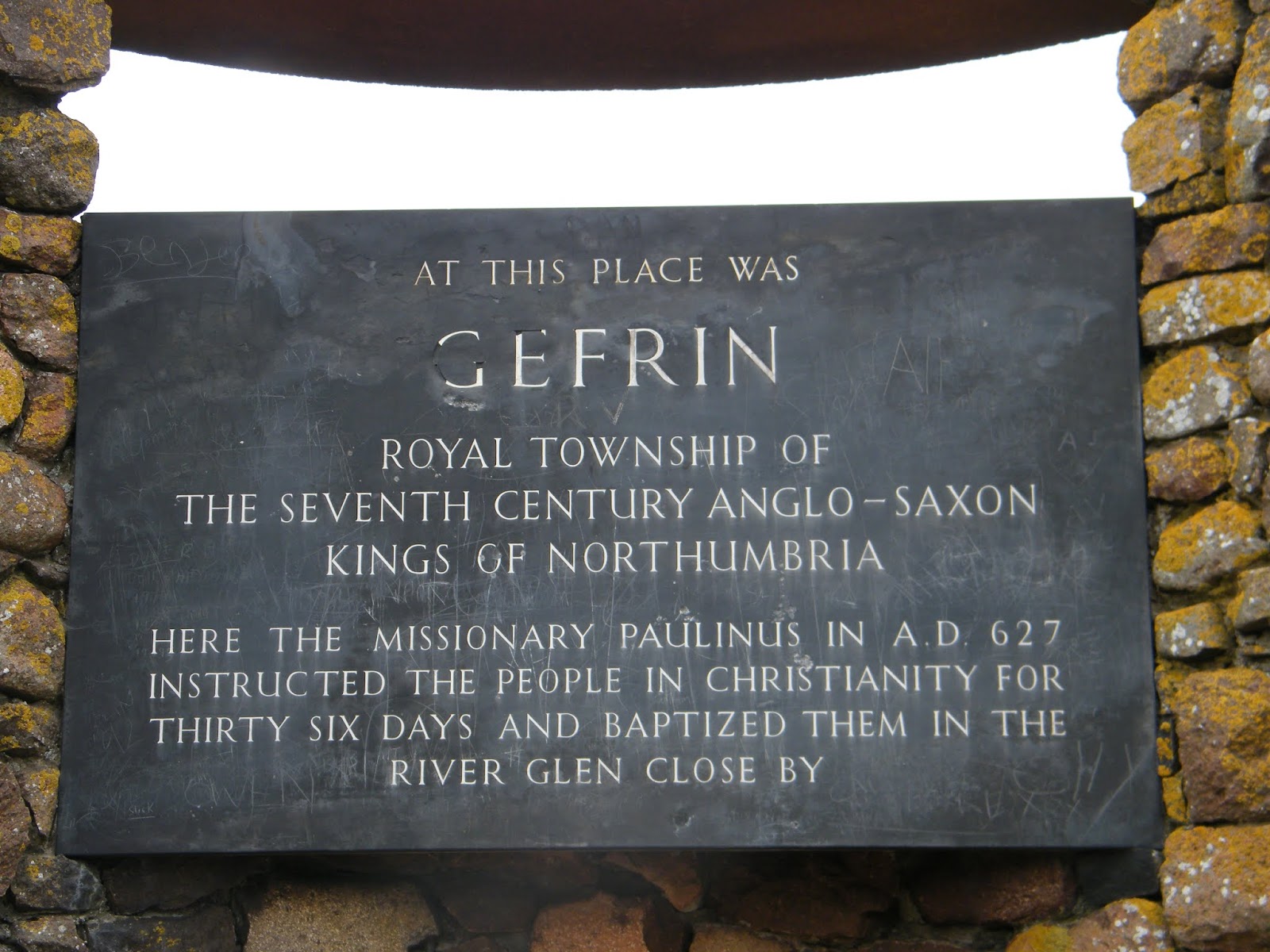
I thought our trip to the northeast would be much easier. For one thing, it’s slightly closer to home, and for another, I knew that the site I wished to visit had been extensively excavated. I remembered seeing the sign at the entrance, and I was sure that there would be something to see. In the seventh century the Northumbrians kings had a magnificent palace on this site. Goodness knows how they got there in the first place because we had to drive round the side of a huge hill/mountain (600-ish metres, if memory serves). There was little in the way of signage but I knew the site would be obvious. This time, given that the road was straight and traffic-free, Hubby responded a little more speedily to my ‘Pull over now!’. And yes, there was the site entrance sign:


And this is what we saw.


But I got my photo!

My book came out on Sep 15 and I’m rather pleased with the colour plate section. The photos speak of calm, of quiet, of historic landscapes and ancient waterways. Hubby knows the truth though. He mutters darkly about writers staying at their desks where they belong. 

[all photos by and copyright of the author unless otherwise attributed]
~~~~~~~~~~~~~~~~

Mercia: The Rise and Fall of a Kingdom is available from 

Amazon

Amberley Publishing

Book Depository (Free worldwide shipping)