New Release: Queen Anna by Tony Riches

  Author Tony Riches has a new release... A crown won in the eye of a storm. A queen who refuses to be broken... Princess Anna of Denmark s...

Showing posts with label Helen Hollick. Show all posts

Monday, 10 March 2025

Guest Post: Helen Hollick's Ghost Encounters

The Lingering Spirits of North Devon...

But Are They Vikings Or Saxons?

By Helen Hollick (With daughter Kathy Hollick)


Everyone assumes that ghosts are hostile. Actually, most of them are not. You either believe in ghosts or you don’t. It depends on whether you’ve encountered something supernatural or not. But when you share a home with several companionable spirits, or discover benign ghosts in public places who appear as real as any living person, scepticism is abandoned. In GHOST ENCOUNTERS: The Lingering Spirits Of North Devon, mother and daughter share their personal experiences, dispelling the belief that spirits are to be feared. 

Ghost Encounters will fascinate all who enjoy the beautiful region of rural South-West England, as well as interest those who wish to discover more about its history... and a few of its ghosts.

(Includes a bonus of two short stories and photographs connected to North Devon)

Book Links:

Pre-order the e-book on Amazon

https://mybook.to/GhostEncounters

THE BATTLE AT APPLEDORE

Originally an Anglo-Saxon settlement, the North Devon coastal town of Appledore today is a picturesque village with narrow cobbled streets, and alleyways known as ‘opes’. Nestling on a steep hillside beside the estuary confluence of the rivers Taw and Torridge, it, or its neighbour, Northam, a little further up the hill, is also the possible site of two important battles, one involving Viking raiders in 878 CE and another a rebellion that, had it been successful, would have altered English history.

An Appledore 'ope'

Appledore began to prosper during the reign of Elizabeth I due to increasing trade with the North American colonies, while Bideford, a few miles up the River Torridge, rapidly became the third largest English trade port for Virginia tobacco. At Northam, a short way outside of Appledore, is a stone set into a wall, commemorating the legend of an ancient battle. Near here, at Appledore, the ghostly sounds of men fighting with shield and sword is occasionally heard – although there doesn’t seem to be accompanying reports of any visual sighting to go with those desperate sounds.

The memorial reads:

“Stop Stranger Stop, 

Near this spot lies buried

King Hubba the Dane, 

who was slayed in a bloody retreat,

by King Alfred the Great”

However, this story may be nothing more than a legend. During the time of Alfred the Great, Hubba the Dane – or more likely the name should be Ubba – landed somewhere with a fleet of ships and was soundly defeated, losing over 1,000 men. All we know for certain is that Hubba/Ubba was slain in the West Country, although there is no evidence to support Appledore and Northam as the location, but... there is possible evidence for a different battle at a later date: the sons of King Harold II who was slain at the Battle of Hastings in 1066, attempted a rebellion against Duke Willliam of Normandy, which, unfortunately, failed.

According to the Anglo–Saxon Chronicle, Manuscript D: ‘After this came Harold’s sons from Ireland, at Midsummer, with 64 ships into the mouth of the Taw, and there heedlessly landed; and Earl Brian [Brian of Brittany] came against them unawares with no small band, and fought against them.’

This is plausible. King Harold II’s mother, Gytha, owned extensive land in North Devon during the 11th century. Harold himself landed at Porlock, a little along the coast at the other end of Exmoor, after a short exile to Ireland in 1052/3, and it is inconceivable that his sons and supporters did not attempt to defeat Duke William after the tragedy of October 14th 1066. The entry in the Anglo-Saxon Chronicle mentions the mouth of the River Taw, so Appledore would certainly fit the bill in terms of location, and so perhaps, it really was here that the fighting took place.

Appledore [photo Simon Murgatroyd

Despite his victory, and subsequent coronation on December 25th 1066 at Westminster Abbey, London, things did not go well for William. England was not as easy to conquer as he had expected. By early 1068 rebellion in the West Country was increasing – this was Wessex, mostly loyal to Earl Godwin, Harold’s father, and then to Harold himself.

Exeter rebelled against William. The town was always a wealthy trade port, and loyal to the Saxon Queens of Emma of Normandy, then Harold’s sister, Edith, wife to Edward the Confessor, and then to Harold himself. (Although Edith surrendered to William soon after Hastings, probably in a move to maintain her royal status and lifestyle – she also had fallen out with Harold early in 1066, so in some way, her capitulation to Normandy could be regarded as treasonous.)

William himself led an army against Exeter, probably because Gytha and Harold’s daughters were there as strong rallying figureheads. After a siege of eighteen days, Exeter surrendered and Gytha and her granddaughters fled abroad. Harold’s common-law wife, Edith Swanneck, was probably also with Gytha.

According to the Anglo-Saxon Chronicle for 1067: “This year Harold's mother, Githa, and the wives of many good men with her, went to [modern day] Flat Holm in the Severn Estuary, and there abode some time; and afterwards went from thence over sea to St. Omer's.”

At the same time, three of Harold’s sons Godwin, Edmund and Magnus, sailed from Ireland where they had been taking refuge, with the intention of raiding as much of southwest England as they could with a fleet of fifty-two ships, provided by Diarmait, the High King of Ireland.

William had already departed Devon, but had left a large force behind, headed by Eadnoth the Staller, an Anglo-Saxon landowner who supported the new king. He fought against the three sons at the Battle of Bleadon, the outcome of which was stalemate. Eadnoth was killed, and the brothers retreated to their ships. After this, Magnus is not mentioned again, so was very likely also killed. The two remaining sons continued to raid along the coasts of Devon and Cornwall., before wintering, again, in Ireland.

They returned with an army and more than sixty ships in June 1069, landing at Appledore and advanced a little inland to Northam. The Norman army, under command of William’s second cousin, Brian of Brittany, and William De Vauville, appointed Sheriff of Devon, were soon there to meet them. The size of the armies is unknown, but the Englishmen, now subjugated by the Normans undoubtedly had no choice but to fight for their new overlords – or lose all they had.

According to Wikipedia, https://en.wikipedia.org/wiki/Battle_of_Northam Harold’s sons and their men fought hard – which is likely – but I’m not sure I agree that they were “unable to retreat because the tide was out.” This implies that they retreated as the tide came back in.

These were Viking longships, shallow on the draught. The confluence of the two rivers, Taw and Torridge, form dangerous currents when the tide is on the turn, plus there is a turbulent sandbar across where river meets sea – it was difficult to navigate safely here by the late 1600s, with the river channels starting to greatly silt up from the mid-1700s. But in 1069? Would this estuary have been as difficult to navigate for experienced sailors, manning Viking-style longships?

Wikipedia states: “For many hours the Normans launched repeated attacks against the raiders’ shield wall, in almost exactly the same way the early stages of the Battle of Hastings had played out. The raiders’ line never broke, but they suffered heavy casualties. As night came, the tide finally returned, and the brothers army escaped to sea, ending the battle.”

I concede that the tide played a big part in any withdrawal – but to cross that river confluence and the bar on an incoming tide? To row, or sail against a heavy, strong tide? No.

Nearly all shipping would go with a current’s flow, not against it. My bet is that Harold’s sons and their supporters fought for as long as they could, but once the high, full, tide was on the ebb... going out ... they dare not wait, for low tide would mean they would be effectively trapped. So as soon as the tide started to go out, they had to take their leave in the hope that there would be chance to fight again another day. *

There was no further rebellion from Harold’s remaining sons. Probably, Diarmait, refused to help any further, seeing it (justifiably) as a lost cause. The brothers went to Denmark, maybe hoping for help from there. It didn’t come, and Harold’s sons probably joined their mother and sisters somewhere near modern Kiev – and then disappear from history. Ideal for fiction writers: a blank page to fill!


* A note in the Wikipedia article seems to support my theory: “In the eleventh century it was usual for ships to depart on the high tide. It has been calculated that on the day of the battle, the high tide would have been in the early evening.”


ABOUT HELEN

Known for her captivating storytelling and rich attention to historical detail, Helen might not see ghosts herself, but her nautical adventure series, and some of her short stories, skilfully blend the past with the supernatural, inviting readers to step into worlds where the boundaries between the living and the dead blur.

Her historical fiction spans a variety of periods and her gift lies in her ability to bring historical figures and settings to life, creating an immersive experience that transports readers into the past. Her stories are as compelling as they are convincing.

Helen started writing as a teenager, but after discovering a passion for history, was published in the UK with her Arthurian Trilogy and two Anglo-Saxon novels about the events that led to the 1066 Battle of Hastings, one of which became a USA Today best-seller. She also writes the Jan Christopher cosy mystery series set during the 1970s, and based around her, sometimes hilarious, years of working as a North London library assistant.

Helen, husband Ron and daughter Kathy moved from London to Devon in January 2013 after a Lottery win on the opening night of the London Olympics, 2012. She spends her time glowering at the overgrown garden and orchard, fending off the geese, helping with the horses and, when she gets a moment, writing the next book...


ABOUT KATHY

When not encountering friendly ghosts, Kathy's passion is horses and mental well-being. She started riding at the age of three, had a pony at thirteen, and discovered showjumping soon after. Kathy now runs her own Taw River Equine Events, and coaches riders of any age or experience, specialising in positive mindset and overcoming confidence issues via her Centre10 accreditation and Emotional Freedom Technique training to aid calm relaxation and promote gentle healing.

Kathy lives with her farmer partner, Andrew, in their flat adjoining the main farmhouse. She regularly competes at affiliated British Showjumping, and rides side-saddle (‘aside’) when she has the opportunity. She produces her own horses, several from home-bred foals. She also has a fun diploma in Dragons and Dragon Energy, which was something amusing to study during the Covid lockdown.


SOCIAL MEDIA LINKS

Website: https://helenhollick.net/

Amazon Author Page: https://viewauthor.at/HelenHollick

Bluesky: @helenhollick.bsky.social

Blog: supporting authors & their books https://ofhistoryandkings.blogspot.com/

Monthly newsletter : Thoughts from a Devonshire Farmhouse https://ofhistoryandkings.blogspot.com/2024/01/thoughts-from-devonshire-farmhouse.html

Kathy’s Official Website:

https://www.white-owl.co.uk/

For additional (and any new ghost encounters!) visit

https://ghostencountersofdevon.blogspot.com/


Friday, 17 May 2024

Out Today - A Memory of Murder by Helen Hollick

Today is publication day for A Memory of Murder by Helen Hollick, the fifth in her series of Jan Christopher Cosy Murder Mysteries.


You might know that Helen is a prolific and hugely successful author of Historical Fiction, including a series about King Arthur and her Seawitch pirate novels. Lately she's branched out into cosy murder stories set in the 1970s.

Helen had wanted to become a journalist when leaving secondary school, but the careers advice was not helpful and instead, she worked in a Chingford library where she stayed for 13 years although she was not very happy there; what she really wanted to do was write. Working at the library of course gave her access to books, and it was there that she came across the Roman historical novels of Rosemary Sutcliff, the Arthurian trilogy by Mary Stewart, and the historian Geoffrey Ashe. She was hooked on Roman Britain - and King Arthur!

Reading everything she could, she realised that she had her own characters of Arthur and Gwenhwyfar (Guinevere), and wanted to tell their stories. She found an agent who placed her with William Heinemann and the first in her Aruthurian Trilogy was published just after her fortieth birthday.


Since then, Helen has had USA Today bestseller success with her novel about Queen Emma, and also written about Harold Godwineson. 


For the last few years she has been taking her readers on high seas adventures with her pirate character Jesamiah Acorne in the highly acclaimed Seawitch novels but, during lockdown in 2020, her writing went in seemingly a very different direction.


But it's not such a leap as you might suppose, for Jan Christopher works in a library too, and many of the incidents and escapades related in the books really happened, as Helen draws on her memories of her years working in Chingford Library.

There, of course, the similarity ends for, unlike Jan, Helen was never witness to murder (thank goodness). All five of the books sit beautifully in their 1970s setting and evoke the sights, sounds, smells and social mores of that era. Jan's uncle is a Detective Chief Inspector, and her guardian since Jan's father was killed when she was young.

Those who've read the previous four books will know this, but in Book Five, we learn more about Jan's earlier life and about her parents. I'll say no more, for fear of spoilers, but I will tell those who already count these books among their favourites, that the gorgeous and glorious Laurie, Detective Sergeant and Jan's fiancé, is still on the scene!

Here's the blurb:

Easter 1973.

The North London library where Jan Christopher works is in upheaval because the decorators are in to spruce the place up, but there is more for her policeman uncle, DCI Toby Christopher, and her fiancé, DS Laurie Walker to worry about than a few inconvenient pots of paint.

An eleven-year-old girl has not returned home after school, and strange ‘gifts’ are being surreptitiously left for the detective chief inspector’s family to find. 

Could these items have anything to do with the unsolved murder, fifteen years ago, of Jan’s policeman father?

As with all of the books in the series, you can be sure there are plenty of red herrings along the way...

A Memory of Murder can be bought HERE

and you can find all of Helen's books HERE

Helen's website is HERE

and you can find her on Social Media:


Praise for earlier books in the series:

“Well-paced with action interspersed with red herrings, shady suspects, and some nice passages of information which, ultimately are inconsequential, but are actually very interesting. Characterisations are excellent – especially Aunt Madge! I love Aunt Madge!”

“An enjoyable read with a twist in who done it. I spent the entire read trying to decide what was a clue and what wasn’t... Kept me thinking. I call that a success.”

“A delicious distraction... What a lovely way to spend an afternoon!”

Sunday, 16 April 2023

Helen Hollick - 30th Anniversary Tour!!

Today I'm delighted to turn the blog over into the capable hands of author Helen Hollick who, this year, is celebrating 30 years since her Arthurian Trilogy, Pendragon's Banner, was first published. Here, she talks about King Arthur, and do scroll down because she's also included an excerpt from Book Two of the Trilogy. Enjoy!

From Roman to Anglo-Saxon – via King Arthur

By Helen Hollick

When I started writing my Pendragon’s Banner Trilogy (way, way back in the mid-1970s) many of the ‘facts’ about Roman Britain, the coming of the Anglo-Saxons and the ‘Matter of King Arthur’ were still quite, well, old-fashioned and out of date compared to what we now know. My Trilogy was accepted for publication in April 1993 one week after my fortieth birthday – hence this tour to celebrate thirty years published and my 70th birthday on April 13th. (Though I might add that this growing old lark is not all it’s cracked up to be!)

Back then, it was still widely believed that after Rome abandoned these shores, the Germanic people – the Angles, Saxons, Jutes and Friesians – invaded Britain in waves of hostile conquest, sweeping the native Britons before them, and pushing them all into Wales. We now understand things much better. Many ‘Romans’ remained in Britain, it was only the administrative lot (probably those who were fed up with the rain) who went back to sunnier climes. The ordinary people were Romano-British, had been for a few generations, and were well settled into their farmsteads. There was some fighting, particularly along the south-eastern coasts of what eventually became ‘Englalond’ with the immigrating Anglo-Saxons, as we collectively call them, but not as much as when the ‘Vikings’ came several centuries later. (Although even then, outside of the lure of wealth-laden churches and monasteries, Norse settlement was probably much more peaceful than the common idea of widespread ‘raping and pillaging’) 

We now know that the Anglo-Saxons more often peacefully integrated, settling near rivers and coasts and intermarrying with the ’locals’. Over time (several generations) the British became the English, Britain became England –and Rome, apart from the roads and decaying cities, became forgotten. 

But legends live on. The most enduring is that of King Arthur. More familiar, perhaps, in the later Medieval tales of knights in armour, courtly love, the quest for the Holy Grail, Guinevere and Lancelot. Those tales belong firmly to the post-Norman conquest and the twelfth to thirteenth centuries. An era where Arthur, if he existed at all, would definitely have not been found.

Post-Roman however? Let’s be frank, Arthur as a king did not exist. (Sorry!) BUT there might have been a strong warlord who rallied against those early Anglo-Saxon immigrants. Kent (which still bears the older pre-Saxon name of Cantii) seems to have been settled peacefully. The area which we now call East Anglia (East Angles) and Suffolk and Norfolk (South Folk and North Folk) maybe there was some fighting there. Maybe an Arthur figure led his cavalry, the Artoriani against them... But who knows?

In my Trilogy (incidentally, among the earliest of the novels that depicted Arthur as post-Roman, not Medieval,) I use the early Welsh legends as my base, where Arthur was not the Christian king that he eventually became, that Gwenhwyfar (the Welsh spelling of Guinevere) did not have an affair with Lancelot ... there is no Lancelot in my trilogy. No Holy Grail, no Merlin. Instead...

A boy who became a man.

Who became a king.

Who became a legend. 

© Helen Hollick

Helen’s new, self-published, editions with beautiful covers designed by Cathy Helms of www.avalongraphics.org are, alas, only available outside of USA and Canada, where the same books are published by Sourcebooks Inc. (The new covers were offered – free – to Sourcebooks, but the offer was declined.)

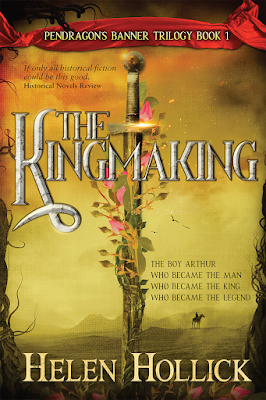
ABOUT THE KINGMAKING (Book 1)

There is no Merlin, no sword in the stone, and no Lancelot.

Instead, the man who became our most enduring hero.

All knew the oath of allegiance:

‘To you, lord, I give my sword and shield, my heart and soul. To you, my Lord Pendragon, I give my life, to command as you will.’

This is the tale of Arthur made flesh and bone. Of the shaping of the man who became the legendary king; a man with dreams, ambitions and human flaws. A man, a warlord, who united the collapsing province of post-Roman Britain, who held the heart of the love of his life, Gwenhwyfar - and who emerged as the most enduring hero of all time.

A different telling of the later Medieval tales.

This is the story of King Arthur as it might have really happened...

“Helen Hollick has it all! She tells a great story and writes consistently readable books” Bernard Cornwell

"If only all historical fiction could be this good." Historical Novels Review

"... Juggles a large cast of characters and a bloody, tangled plot with great skill. " Publishers Weekly

"Hollick's writing is one of the best I've come across - her descriptions are so vivid it seems as if there's a movie screen in front of you, playing out the scenes." Passages To The Past

"Hollick adds her own unique twists and turns to the familiar mythology" Booklist

"Uniquely compelling... bound to have a lasting and resounding impact on Arthurian literature." Books Magazine

The Kingmaking: Book One

Pendragon’s Banner: Book Two

Shadow of the King: Book Three

(contains scenes of an adult nature)

BUY THE BOOKS:

THE PENDRAGON's BANNER TRILOGY 

New Editions available worldwide except USA/Canada

https://mybook.to/KingArthurTrilogy

Available USA/Canada 

US TRILOGY

CANADA TRILOGY


ABOUT HELEN:

First accepted for traditional publication in 1993, Helen became a USA Today Bestseller with her historical novel, The Forever Queen (titled A Hollow Crown in the UK) with the sequel, Harold the King (US: I Am The Chosen King) being novels that explore the events that led to the Battle of Hastings in 1066. Her Pendragon’s Banner Trilogy is a fifth-century version of the Arthurian legend, and she writes a nautical adventure/fantasy series, The Sea Witch Voyages. She has also branched out into the quick read novella, 'Cosy Mystery' genre with her Jan Christopher Murder Mysteries, set in the 1970s, with the first in the series, A Mirror Murder incorporating her, often hilarious, memories of working as a library assistant.

Her non-fiction books are Pirates: Truth and Tales and Life of A Smuggler. She lives with her family in an eighteenth-century farmhouse in North Devon and occasionally gets time to write...

Website: https://helenhollick.net

All Helen’s books are available on Amazon: 

https://viewauthor.at/HelenHollick

Subscribe to Helen’s Newsletter: https://tinyletter.com/HelenHollick

Her Blog: https://ofhistoryandkings.blogspot.com/

Facebook: https://www.facebook.com/helen.hollick

Twitter: @HelenHollick https://twitter.com/HelenHollick

Follow Helen’s Celebration Tour https://www.helenhollick.net/ 


EXCERPT FROM PENDRAGON’S BANNER

Book 2 of the Trilogy


“Council will not like it.” Cei said.

“I do not ask for, nor want, the council’s opinion,” Arthur answered.

Cei sighed; only three years as King, and already Arthur and his council were squabbling like dogs after the same bone. 

“There are those,” Cei tried again, “who say that to spend more than a week discussing treaties of alliance with a defeated enemy is not good judgment.” 

Arthur, mending a broken bridle strap, made no answering comment. The hail that had sputtered on and off all day drummed a tattoo on the roofing of the leather tent and bounced like tossed pebbles on the worn, hollowed patch of mud-packed turf by the open entrance flap. 

Watching the pea-sized balls of ice a moment, Cei stared, fascinated as the ground turned white - then the sudden-come storm ceased. The wind whipped up the dark clouds and sent them scurrying from a dazzling blue sky. Beyond the tent, everything dripped and gleamed, the white ice melting into fairy-sized diamond-drops. “For Hengest,” he continued as if he had not ceased talking, “your council could see reason behind the giving of territory. Wrong or right, he had been originally invited here to fight on our side by Vortigern - God rot his mouldering soul.” 

“I did not give,” Arthur interrupted. “I rent Hengest those Cantii lands, rent for a large payment of taxation. He rules under my gaze and is ultimately answerable to me. As this man, Icel, shall be when he edges around to seeing reason.” 

“Fah!” Cei swarmed to his feet, toppling his stool backwards. “Reason? It is already reasonable that he still has his head after rebelling against us; it is already reasonable that those who follow him are alive, not dangling at the end of ropes!” 

Quietly, Arthur finished the mending of the strap, fixed it back to the bridle. “So I have Icel executed? And then one day, one day very soon, these Anglian settlers will find for themselves another proud young princeling to follow and we will then need to fight them.” He stood, hung the bridle on a nail jutting from the tent pole, faced his cousin and second-in-command with outspread hands. “I have shadow-chased this Anglian leader from the Treanta river to the coast, from the Fosse Way down to the forests. If I grant a legitimate holding of land then Icel is beholden to me. And whenever a new cub decides he wants more than a ploughed field to crow over, he will first have to square that wanting with Icel, not with me.” 

Pouting, Cei answered, “Too much is being given to these damn Saex. The Council of Britain do not like it.” His thoughts added, Neither do I. 

Arthur grinned, irritatingly friendly, knowing full well those unspoken thoughts. “Ah, but then I am King; a king is expected to do things that are not liked.” His grin broadened. “A prerequisite of the position. The ability to annoy.” 

Cei grunted. “Oh aye, you have a talent for rubbing people the wrong way. Always have done, even as a child.” 

Arthur laughed to hide the bitter memory of his unpleasant childhood. He poured wine for himself and Cei, handed the goblet to his cousin. “I intend to squeeze everything I can from Icel. Gold, leather, grain. Hostages. He will find submission hard.” 

Righting the stool, Cei seated himself again. “What if he does not agree to your demands, eh? He might not.” 

Arthur sat also, pushing his booted feet nearer the fluctuating warmth of the brazier. Two nights until Samhain, the night the dead walked. He would rather be tucked within the warmth of Gwenhwyfar’s bed at Lindum by then. Icel was a proud man, would welcome death; even the threat of the living death of blinding and male mutilation would not daunt him. There would have to be something more, some promise of what Arthur would do if the Anglian did not offer total submission. The Pendragon had once made such a thing clear to Hengest, and then not so long since, to Winta of the Humbrenses. 

“Your people and your family shall pay for defeat. The men will lose their hands and eyes, the women and children will be taken into slavery, used as whores. Until natural death releases them, they will face great misery and suffering. Your settlements will be burnt, and your cattle slaughtered. Not you. You will be taken to a fortress far away. You will be guarded, but you will have light and warmth and the best food; a comfortable bed, even a woman to share that bed. On fine days you will be allowed to ride and hunt, you will be treated as an honoured guest with no privilege spared, save that of your freedom to leave. And while you live in this luxury, you will think of your wife and your children. Of their distress and pain.” 

Winta had seen the sense in not trying his luck against this British lord who meant every word he said, for Winta was not full of greed and wanting as Hengest had been, and was older and wiser than the young coxcomb Icel. He valued too highly all that could be lost were victory not to come his way, and so had not even tried for the winning of it. By joining with the Pendragon his reward had proved great and welcome. Winta was already a wealthy man, and by uniting with the British, trade that was already flourishing would increase - double, treble. Soon he would be able to extend his held land, amicably, with Arthur’s consent and permission, for Winta was wily enough to realise that there was more than one way to obtain a title of King. 


Friday, 24 February 2023

History and Mystery - by Helen Hollick

Today I'm delighted to turn the blog over to author Helen Hollick, whose new book in her Cosy Murder Mystery series has just been published. Over to Helen:


History and Mystery

By Helen Hollick

Apart from the fact that those two words rhyme nicely, both are very popular subjects in their own write where fiction is concerned. (See what I did there? Write/right!) Readers love an intriguing mystery to solve, and if the sleuthing is set in the past, all the better. (Think Cadfael by Ellis Peters for instance, probably the most well known of the genre.) In a way the reader is getting two for the price of one: a historical novel and a murder mystery.

The ‘cosy mystery’ (coZy in the USA) is increasing in popularity. ‘Cosy’ meaning a light, easy read, usually with an amateur female sleuth, who has a romantic interest and gets mixed up in a murder or a mystery to solve. Some of these mysteries are village, countryside or seaside based while many of the popular ones are also set in the past, from Rome to Regency, from Saxon to Victorian Saxe-Coburg. I decided to base my Jan Christopher Mysteries in the 1970s, far enough back to be classed as ‘historical’ near enough to remember those years.

Jan is a young North London suburb library assistant – as I was back then in the 1970s, hence my choice of era and setting. Orphaned as a child her Aunt Madge and uncle, DCI Tobias Christopher, adopt her, and when she meets the DCI’s new Detective Constable, Lawrence (Laurie) Walker it is a case of love at first sight. But is their blossoming romance to be hindered by the discovery of a brutal murder?

I admit here that I thought I could remember a lot about the ‘70s, but I soon discovered that I needed to do as much research for these books as I did for my ‘serious’ historical fiction. It’s getting the little details right that matter, the correct price of a bus ticket or a chocolate bar. Loose leaf tea, not teabags. Blue police telephone boxes (as in Dr Who’s TARDIS), no mobile phones in the 1970s. No computers, no Internet – no DNA! (Ah, but there were fingerprints!)

In some ways, I initially thought that this lack of ‘modern techniques’ would be a hindrance for a mystery series, but I soon discovered an advantage because I know very little about police procedures, and even less about murders. These bits I glean from TV shows such as Morse, Lewis, and Foyle’s War – the rest I either use what I remember, research, or make up.

And making things up when writing an entertaining cosy mystery series can be a lot of fun!

*

Jan Christopher #1 A Mirror Murder

Jan Christopher #2 A Mystery of Murder

Jan Christopher #3 A Mistake of Murder 


Recently released: A MISTAKE OF MURDER by Helen Hollick

The third Jan Christopher Cosy Mystery

Was murder deliberate - or a tragic mistake?

A series of burglaries and an elderly person is murdered. Can library assistant Jan Christopher help discover whether murder was a deliberate deed – or a tragic mistake?

January 1972. The Christmas and New Year holiday is over and it is time to go back to work. Newly engaged to Detective Sergeant Lawrence Walker, library assistant Jan Christopher is eager to show everyone her diamond ring, and goes off on her scheduled round to deliver library books to the housebound – some of whom she likes; some, she doesn’t.

She encounters a cat in a cupboard, drinks several cups of tea... and loses her ring.

When two murders are committed, can Jan help her policeman uncle, DCI Toby Christopher and her fiancé, Laurie, discover whether murder was a deliberate deed – or a tragic mistake?


About Helen:

First accepted for traditional publication in 1993, Helen became a USA Today Bestseller with her historical novel, The Forever Queen (titled A Hollow Crown in the UK) with the sequel, Harold the King (US: I Am The Chosen King) being novels that explore the events that led to the Battle of Hastings in 1066. Her Pendragon’s Banner Trilogy is a fifth-century version of the Arthurian legend, and she writes a nautical adventure/fantasy series, The Sea Witch Voyages. She has also branched out into the quick read novella, 'Cozy Mystery' genre with her Jan Christopher Murder Mysteries, set in the 1970s, with the first in the series, A Mirror Murder incorporating her, often hilarious, memories of working as a library assistant.

Her non-fiction books are Pirates: Truth and Tales and Life of A Smuggler. She lives with her family in an eighteenth-century farmhouse in North Devon and occasionally gets time to write...


Links:

A Mistake of Murder  by Helen Hollick available from an Amazon near you, or order from any bookstore. Paperback and e-book available.

https://mybook.to/MISTAKEofMURDER

Helen’s Amazon author page: 

https://viewauthor.at/HelenHollick

Helen’s Website: https://helenhollick.net/

Subscribe to Helen’s Newsletter: https://tinyletter.com/HelenHollick


Wednesday, 13 October 2021

Why did Harold Godwineson go to Normandy - by Helen Hollick

 As we continue our tour of Saxon England, Helen is my guest today on this, the anniversary of the battle of Hastings:


Why did Harold Godwineson go to Normandy?
by Helen Hollick

The Battle of Hastings. 14th October 1066 - probably the most famous date in English history. (Funnily enough, the next most famous is also a '66' - 1666, the Great Fire of London.) The battle came about because Duke William of Normandy considered that he had been promised the throne of England by Edward the Confessor, probably in circa 1052 when the Godwine family were exiled, and Edward was favouring his Norman friends. The Duke, William, was Edward's kindred - his Great Aunt, Queen Emma, was Edward's mother. So, with Edward as yet childless and with no obvious heir to the throne, Bill probably thought he was in with a good chance.

Earl Godwine and his family, one of whom was Harold, Earl of East Anglia, reclaimed their positions of authority and Edward's Norman mates scuttled back to Normandy (where they belonged) with Earl Godwine's youngest son, Wulfnoth, and grandson, Hakon, as hostages.

Now, if Edward had made such a promise it would have been totally void because England, the Anglo-Saxons, did things very differently back then. The king was chosen by the council, the Witan. Elected. Best man for the job. Yes, usually this would have been the eldest son, the aethling, but it would have been highly unlikely that William would have been considered.

Skip forward ten or so years.

In 1063 or '64 Harold, now Earl of Wessex, went to Normandy. We do not know why, but we know (sort of) what happened because the events are recorded in the Bayeux Tapestry (which is actually an embroidery, not a tapestry.)

The Normans, after 1066, claimed that Harold went as an envoy of King Edward (who by now was getting old and frail) and to re-iterate William's role as heir. Again - highly unlikely! Given that his brother and nephew were still being held as hostages, is it not more logical that Harold went to get them back?

Harold boarding a ship bound for Normandy
at his home at Bosham Sussex
- note the steps...


and here's my friend James
sitting on very similar steps
 at Bosham in the 21st century!

Things went awry, however, for his ship was blown off course and he ended up a prisoner of one of William's neighbours, Guy de Ponthieu ... no matter, the Duke, with much indignation, secured Harold's release. From there on, the visit seemed quite congenial, Harold even accompanied William on campaign into Brittany, seeing at first-hand how the Normans fought (and how ruthless William was - he was known as 'Bastard' for both uses of the word.)

Again, we know all this because of the Tapestry, which includes a scene where Harold rescues two men from drowning in the river Cousenon, at  Mont Saint Michel. (The tide  comes in faster than a man can run there...)
Here Harold is rescuing two men
from the river

Eventually, it was time to go home, but William would not allow this until Harold had sworn an oath of allegiance... sworn to support William's claim to England.

Harold was forced to swear
while touching holy relics

The thing is ... William tricked Harold. He was made to swear a holy oath, to swear to God, BUT an oath made under duress is not a binding oath. If Harold hadn't sworn, would he, and his men, ever have seen their freedom again? Add to that, in Anglo-Saxon times a lord would forfeit his honour if he did not protect the men who loyally served him. What was the greater? To swear an unbinding oath under duress, with no choice but to make it, or to swear, falsely, in order to save the freedom - or lives - of your faithful followers?

Harold had no choice. He swore the oath, and did, indeed return to England with his nephew, Hakon.

Wulfnoth was never to see his freedom again. And Hakon died  alongside Harold, at the great battle of Hastings.

History, the year 1066 might have been entirely different if Harold had not gone to Normandy. On the other hand, because he did go, because he accompanied William on campaign, Harold knew exactly what Duke William was like. Knew he was obsessive - and ruthless. Knew that he would have to keep the Norman Duke out of England at all cost -whatever the cost, and whatever he had to do...

Read the entire story:

Harold the King (UK & Australia)
I Am The Chosen King (US & Canada)
(same book - different title)

About Helen:

Helen Hollick and her family moved from north-east London in January 2013 after finding an eighteenth-century North Devon farm house through being a ‘victim’ on BBC TV’s popular Escape To The Country show. The thirteen-acre property was the first one she was shown – and it was love at first sight. She enjoys her new rural life, and has a variety of animals on the farm, including Exmoor ponies and her daughter’s string of show jumpers.

First accepted for publication by William Heinemann in 1993 – a week after her fortieth birthday – Helen then became a USA Today Bestseller with her historical novel, The Forever Queen (titled A Hollow Crown in the UK) with the sequel, Harold the King (US: I Am The Chosen King) being novels that explore the events that led to the Battle of Hastings in 1066. Her Pendragon’s Banner Trilogy is a fifth-century version of the Arthurian legend, and she also writes a pirate-based nautical adventure/fantasy series, The Sea Witch Voyages. Despite being impaired by the visual disorder of Glaucoma, she is also branching out into the quick read novella, 'Cosy Mystery' genre with the Jan Christopher Mysteries, set in the 1970s, with the first in the series, A Mirror Murder incorporating her, often hilarious, memories of working for thirteen years as a library assistant.

Her non-fiction books are Pirates: Truth and Tales and Life of A Smuggler. She also runs Discovering Diamonds, a review blog for historical fiction, a news and events blog for her village and the Community Shop, assists as ‘secretary for the day’ at her daughter’s regular showjumping shows – and occasionally gets time to write... 

Website: https://helenhollick.net/

Amazon Author Page: https://viewauthor.at/HelenHollick 

Blog: https://ofhistoryandkings.blogspot.com/

Twitter: @HelenHollick

Facebook: https://www.facebook.com/HelenHollick

Newsletter Subscription: http://tinyletter.com/HelenHollick

Monday, 11 October 2021

Stepping Back into Saxon England: What If? by Helen Hollick


Stepping Back into Saxon England
What If?
By Helen Hollick


WHAT IF...? by Helen Hollick


1066 Turned Upside Down, is a short  story collection of alternative stories for the events of that year – the year of King Harold II’s coronation, the year of the Battle of Hastings and the Norman Conquest of England.

Written by nine different authors – including myself and co-blog-tourist Annie Whitehead – these stories explore what might have happened if William the Conqueror had been beaten at Hastings, if Harald Hardrada had won at Stamford Bridge or if Edward the Confessor had died with an heir ready to take his crown. 1066 Turned Upside Down explores a variety of ways in which that momentous year could have played out very differently.

But what if things had been different before 1066? How far back do we go to alter the course of history to erase the Norman Conquest? What if history was different after 1066?

Where to start!

Things might have been different if Boudica had beaten Rome during her great rebellion in AD 60 or 61, although I suspect that Rome would have come back in greater force. What if there had not been the Anglo-Saxon migration in the early sixth century? (Contrary to ‘old fashioned’ thinking, these Germanic tribes did not come in hoards to rape, pillage and drive the local Brits into Wales... settlement took several generations of mostly peaceful integration between the two populations.) What if they ‘went south’ instead? To what is now France and Spain? (Much better weather than England!) Again, though, it is probable that they would have still come, maybe 100 years or so later, and perhaps already converted to Christianity.

Ah, there’s another one! What if the Romans/Britons/ Saxons/Vikings had not converted to Christianity? What if the Faith hadn’t spread, had fizzled out before it even got started? Apart from a lot of hungry lions, we would not have our grand cathedrals – nor our Western way of life (no divorce entanglements for Henry VIII!) Would the dominant religion now be Pagan, Jewish, Muslim, Hindi...? No Christianity = no Crusades. No glory for Richard the Lionheart ... ah, but if there had not been a Norman Conquest, there would have been no Plantagenets anyway.

Tomb of Richard I

What if the Vikings had not happened, or they had not thought this little, often very wet Isle, worth bothering with? If there had been no Christianity, and no churches, this is entirely feasible. The Vikings came for the plunder. The gold and riches in our churches. (Although, perhaps alternative faiths still had the riches – so they might still have come.)

What if - assuming, so far that history had not changed and Duke William had seized England for himself - what if Mathilda, daughter of Henry I had been crowned as Queen? No civil war between her and Stephen. But then Henry II, her son, would still have become King.

the spread of the Black Death

What if there had been no Black Death in 1348/49? (The term ‘Black Death’ was not used until the late 17th century.) As Wikipedia states: "The most immediate consequence was a halt to the campaigns of the Hundred Years' War. In the long term, the decrease in population caused a shortage of labour, with subsequent rise in wages, resisted by the landowners, which caused deep resentment among the lower classes. The Peasants' Revolt of 1381 was largely a result of this resentment, and even though the rebellion was suppressed, in the long term serfdom was ended in England. The Black Death also affected artistic and cultural efforts, and may have helped advance the use of the vernacular." 

So thus ended the consequence of the Norman Conquest, and the rise of English used instead of French and Latin among the higher classes, government and the church. But there probably would have been another plague... (as we well know 2020 - Covid 19!)

No Wars of the Roses maybe? Richard III won at Bosworth, so no Tudors – one main result being England would have remained Catholic. Or Katherine of Aragon had borne a healthy son? Meaning no reign of Mary Tudor or  Elizabeth I. (A lot of people would have stayed alive with no burnings and beheadings of Catholics or Protestants.) Spain might have triumphed with their Armada, so no Stuarts on the English throne. I reckon the Protestants wouldn’t have fared so well, though.

In turn, no English Civil Wars. Charles I reigned to a ripe old age, no Oliver Cromwell (although his ideas didn’t survive anyway, so maybe we can discount that era of history). Charles II might have had a son, so exit William and Mary. (I was talking to a young friend, also called William, about these two. We decided that as William was William of Orange, Mary must have been Mary of Marmalade.)

Or perhaps the Duke of Monmouth would have won at Sedgemoor in 1685. If any one of Queen Anne’s children had survived – no George of Hanover.

James Scott, 1st Duke of Monmouth

Ah, no George III! No war of Independence with those Colonials across the Atlantic! Maybe Britain and the United States would still be conjoined? America's monarch would be Elizabeth II? There again, slavery would still have happened because of tobacco, sugar, cotton... the Industrial revolution continued to roll... but maybe no Queen Victoria? No Albert... no Albert Hall in London. Would we still have Christmas trees?

"That pretty German toy, a Christmas tree" (1848),
The Illustrated London News

I’ll stop there, but I find it interesting that we would probably still have Queen Elizabeth II as our monarch. Let’s assume Edward VIII had not abdicated in 1936, had still married Wallis Simpson.

In ‘real’ life they had no children, so when he died in 1972 his successor would have been ... Elizabeth II.

 What other 'what if's' - feel free to leave a comment and share your ideas!

Buy the book
from Amazon
now also available in paperback

(images from Wikipedia)

About Helen:

Helen Hollick and her family moved from north-east London in January 2013 after finding an eighteenth-century North Devon farm house through being a ‘victim’ on BBC TV’s popular Escape To The Country show. The thirteen-acre property was the first one she was shown – and it was love at first sight. She enjoys her new rural life, and has a variety of animals on the farm, including Exmoor ponies and her daughter’s string of show jumpers.

First accepted for publication by William Heinemann in 1993 – a week after her fortieth birthday – Helen then became a USA Today Bestseller with her historical novel, The Forever Queen (titled A Hollow Crown in the UK) with the sequel, Harold the King (US: I Am The Chosen King) being novels that explore the events that led to the Battle of Hastings in 1066. Her Pendragon’s Banner Trilogy is a fifth-century version of the Arthurian legend, and she also writes a pirate-based nautical adventure/fantasy series, The Sea Witch Voyages. Despite being impaired by the visual disorder of Glaucoma, she is also branching out into the quick read novella, 'Cosy Mystery' genre with the Jan Christopher Mysteries, set in the 1970s, with the first in the series, A Mirror Murder incorporating her, often hilarious, memories of working for thirteen years as a library assistant.

Her non-fiction books are Pirates: Truth and Tales and Life of A Smuggler. She also runs Discovering Diamonds, a review blog for historical fiction, a news and events blog for her village and the Community Shop, assists as ‘secretary for the day’ at her daughter’s regular showjumping shows – and occasionally gets time to write... 

Website: https://helenhollick.net/

Amazon Author Page: https://viewauthor.at/HelenHollick 

Blog: https://ofhistoryandkings.blogspot.com/

Twitter: @HelenHollick

Facebook: https://www.facebook.com/HelenHollick

Newsletter Subscription: http://tinyletter.com/HelenHollick