New Release: Queen Anna by Tony Riches

  Author Tony Riches has a new release... A crown won in the eye of a storm. A queen who refuses to be broken... Princess Anna of Denmark s...

Tuesday, 27 July 2021

Review: The First English Hero: The Life of Ranulf de Blondville by Iain Soden

 Once again, the lovely people at Amberley have sent me a review copy of one of their newly-released titles.


"Ranulf de Blondeville, 6th Earl of Chester, was, by his own declaration, a Norman. Possessing, at one time or another, a Dukedom, numerous Earldoms and Viscounties on both sides of the Channel, he owned and controlled about a third of both England and Normandy. Skilled in siegecraft and loyal to a fault, Ranulf spent a lifetime at war alongside the impetuous King Richard the Lionheart and then his reviled brother King John, ably commanding their armies and earning a reputation for his offensive spirit and his tenacity in defence. Loyal to a fault, in 1215 he refused to sign Magna Carta and spent the next two years as England’s main defence against a French-backed rebel army. Offered the regency of all England, he graciously refused. His military might tipped the balance in support of the child king Henry III. Ranulf’s reputation grew further when he went on crusade, covering himself with glory and winning the admiration of Rome. He went on to use his experience of war to build spectacular castles, and his diplomacy secured economic prosperity for much of the Midlands. When he died at the height of his fame in 1232, it was said in France that the devil himself had thrown his soul out of hell – even in death he was simply too hot to handle! By Ranulf’s own declaration, his body was that of a foreigner; but surely his heart and soul belong to England. This is the story not just of one man, but of the birth pangs of the English nation."

I very much enjoyed this book. Iain Soden has the knack of writing in a conversational way, whilst still presenting all the history in great detail. He puts Ranulf squarely in his time: a period where the nobility were tested by the whims of the kings, where kings succeeded and wrought changes, and where many of the high-born - royalty included - held lands on either side of the channel, and thus often owed fealty to rival kings.

Ranulf appears to have steered his course prudently through these choppy waters and, as the author points out, the low-points of his career came about largely because he was stuck on the wrong side of the channel when it mattered. 

It quickly becomes apparent, reading this book, that Ranulf suffered from being a contemporary of William Marshal, and perhaps would be better remembered were it not for that. However, he clearly inspired affection and loyalty, and his career was, in the main, hugely successful. Even his bitter enemy, with whom he'd argued to the point of swords being drawn, had kind words to say about him after his death. Earlier, when that same enemy (Hubert de Burgh) had fallen from favour and was seeking sanctuary, Ranulf defended him.

It also speaks volumes that when Ranulf was known to be dying the king ( Henry III) moved his court suddenly from Reading to Wallingford in what seems to have been a desire to pay his last respects to Ranulf.

His marital life was perhaps less successful, given that there was little but mutual animosity in his first marriage and his second seems to have been an arrangement rather than a love match, but I was pleased that the author gave us as much detail about that as is presumably available. I also liked that, where appropriate, he offered details about the castles and other locations mentioned in the book and whether they are still standing, and how accessible they are. Of particular interest was the detailed description of Bolingroke (Lincolnshire).

Occasionally I would have liked more detail, such as when Ranulf's style of government on his own lands is mentioned; it would have been interesting to know a bit more about the workings of estate management during this period, but with a wealth of material and a large time span to get through, I imagine some topics had to be given a little less attention.

I was interested and, impressed, that Ranulf opposed measures to expel the Jews on his lands. This may not have been for entirely altruistic reasons, but he was brave enough to stay out of step on this matter. His land-drainage programme, again whilst presumably designed to boost his own coffers, also benefited those who lived on and worked the land.

Ranulf appears to have shared something else with William Marshal - an ability to continue fighting until well into old age. He was sent back to France by the king at the age of fifty-nine, to oversee the campaign there.

Charting a long life, the books takes us through the reigns of several kings, from the reign of Henry II, through those of Richard I and John, to Henry III. It was a time of great change, fluctuating fortunes, and wavering loyalties. Much to take in, but the history of this period is presented in a chronological way and is easy to follow even if the reader is not fully knowledgeable of the period. There are some suggestions of alternative theories, such as what really happened to King John's jewels, but they are offered as just that: alternative theories and I don't think there's anything controversial here.

Throughout, Ranulf remains 'centre-stage' and there's no flying off at tangents. Although this book gives detailed coverage of these times, it never loses its way, keeping the focus on its subject.

The First English Hero: The Life of Ranulf de Blondville is available from 

Amberley Books

Amazon

and all good bookshops

Wednesday, 23 June 2021

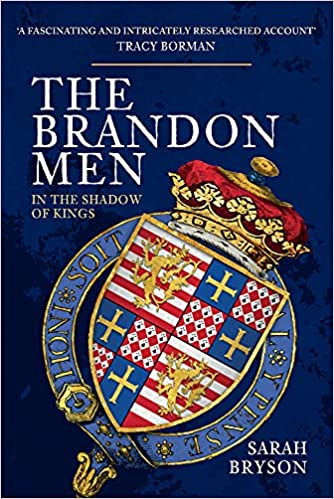
Review: The Brandon Men - Sarah Bryson


Sarah Bryson's new book, The Brandon Men: In the Shadow of Kings, has an interesting title. I knew, or thought I knew, about Charles Brandon, Duke of Suffolk. So who were the others?

Of course, when one stops to think, Charles Brandon didn't appear from nowhere. As the blurb for this excellent new book says:

Four generations of Brandon men lived and served six English kings, the most famous being Charles Brandon, Duke of Suffolk, best friend and brother-in-law to King Henry VIII. Yet his family had a long history tied closely to the kings of the Wars of the Roses back to Henry VI. Charles Brandon’s father, Sir William Brandon, supported Henry Tudor’s claim on the throne and became his standard bearer, dying at the Battle of Bosworth. Charles’s uncle, Sir Thomas Brandon, was Henry VII’s Master of the Horse, one of the three highest positions within the court. Charles’s grandfather had ties with Henry VI, Edward IV and Richard III. These men held important offices, made great sacrifices, walked the fine line between being loyal courtiers and traitors, and even gave their lives, all in the name of loyalty to the king they served. No more shall the Brandon name be an obscure reference in archives. It is time for them to emerge from the shadows of history.

The author explains at the outset that of the earlier Brandon men, there is less in the way of historical record, but she makes the most of what is available, detailing as vividly as possible the careers of the men who brought the family up from rather humble beginnings to the highpoint at which Charles Brandon became Henry VIII's trusted friend.

What is evident is that this was far from a foregone conclusion. As Ms Bryson points out, Sir William Brandon II was the only member of the nobility on Henry Tudor's side to be killed at Bosworth. This left his wife, and her son Charles, then only one, in somewhat of a precarious position.

However, Charles Brandon thrived and, inevitably, most of the book's pages are taken up with his story. Some of it, such as his treasonous marriage to Henry VIII's sister, I knew, but this very readable book gives the background to that, tells us about Charles' earlier and subsequent marriages, and explains, wherever possible, what happened to the various Brandon women, too.

There is also extensive detail about his dealings in East Anglia, his diplomatic missions and military enterprises, and what comes across is a real sense of his character. Whilst reading, I felt I was really getting to know the man.

It's easy, I suppose, to assume that Charles was just another rich playboy at the young Henry VIII's court and this simply isn't the case. His family had risen through loyal service and Charles fared better than many of Henry's friends for, as the author points out, he knew Henry the man, as well as Henry the king. He wasn't universally liked, but he kept his head, and the friendship of the king where others failed in both those respects.

It is astonishing that a family could rise to such lofty heights in relatively few generations, and sobering that it all fell away so quickly, too.

Ms Bryson has a very engaging style, and the book, whilst being packed with historical detail and lengthy quotations from primary source documents, is also an easy and enjoyable read.

Highly recommended.

[Thank you to Amberley Books for providing me with an advance copy, with no obligation to review.]


The book is available from:

Amberley Books

Amazon 


Monday, 21 June 2021

Review: The Bastard's Sons by Jeffrey James

The lovely folk at Amberley have a habit of sending me review copies of their history books and I'm always delighted to read them.


Those who know me and my historical preferences and sympathies might be surprised that I said "Yes please" to the offer of a copy of this book. You might also think that the title shows some bias, calling William of Normandy a bastard, rather than the Conqueror.

However, there is no bias, but the title accurately reflects the real and ongoing problem faced not only by William but also his children. William was, indeed, illegitimate, and his succession to the dukedom of Normandy was never a given. Even as a child, he had guards sleeping in his bed, protecting him at all times.

We pretty much all know what happened in 1066, and that England fell under his boot. Things were far from settled, even then, and William had uprisings to deal with.

Where things got a tad messier though, was when his sons came of age. Robert, William (Rufus) and Henry all expected a chunk of inheritance from their father, but it was tricky. You'd think England would be the prize catch but no, the 'family' lands in Normandy were more of a prize than some conquered country.

Robert rose up against his father and I was at times reminded of the travails of Henry II, who had similar tussles with his adult sons - a point made by the author here.

This a very accessible account of the lives, careers and fortunes of William's sons, full of interesting insights. The author points out that the Normans, though reference is often made to their 'Viking' heritage, were no "better or worse in a fight than any other Frenchman" and that at Hastings they fought like the Franks whereas it was the English who fought more like the Vikings of old. 

Henry's shrewd character comes across particularly well, and the author notes that as soon as his father died, Henry secured the pre-weighed coinage that would come to him, knowing that no land would. 

As I've already hinted, this is not a period which I've researched in any great depth, but the author uses primary sources, and analyses them, so I'm confident that the history is sound.

His writing style is conversational, and I found it an easy, but satisfyingly detailed read. There are maps aplenty, the colour plates are numerous and informative, and the author has also included a timeline and three useful and interesting appendices, including a touching letter from Stephen of Blois to Adela, his wife (daughter of William).

Available Amberley Books, from Amazon  and from all book shops.

Monday, 7 June 2021

Review: Tithe Barns by Joseph Rogers

Tithe Barns by Joseph Rogers is a little gem of a book. 

Crammed with lovely photographs and illustrations, it takes the reader on a fireside journey and makes you feel rather nostalgic looking at and reading about these wonderful medieval buildings and their quaint village settings.

Perhaps lockdown heightened my enjoyment too, going some way to satisfying my craving for trips out to different parts of the country.

When I get out and about again I shall keep my eye out for these and other such buildings, with a new appreciation for them and their history.

It was especially interesting to see how some have survived, some have fallen to decay and some have been repurposed, in an astonishing variety of ways: as MOT garages, restaurants, and wedding and rock convert venues.

Mr Rogers writes in a conversational style, and clearly has a great affection for his subject matter.

A real little jewel and well worth reading.

[I was sent a copy of this book by the publishers, with no obligation to review.]

Available to pre-order at: Amberley Books

and at Amazon

Tithe Barns will be released on 15 June 2021

Monday, 3 May 2021

Interview: Author Karen Heenan

 A few months ago I had the pleasure of reading Karen Heenan's new novel, A Wider World, and reviewing it for Discovering Diamonds.


"Memories are all he has… Now they could save his life. Returning to England after almost five years in exile, Robin Lewis is arrested and charged with heresy by the dying Queen Mary. As he is escorted to the Tower of London, Robin spins a tale for his captor, revisiting his life under three Tudor monarchs and wondering how he will be judged—not just by the queen, but by the God he stopped serving long ago. When every moment counts, will his stories last long enough for him to be saved by Mary's heir, the young Queen Elizabeth?"

Today, I'm delighted to welcome Karen to the blog, to talk a little more about this wonderful book.

AW: Congratulations on the release of A Wider World. Having read Songbird (Karen's debut novel), I knew of Robin as a character. Did you know when you were writing Songbird that Robin would have his own book?

KH: I had no idea that Robin would have his own book. Actually, I thought Songbird was a standalone book, and had a completely different project in mind once it was published. I didn’t find Robin particularly likeable in Songbird, even when he improved (somewhat), and so between that and thinking I was done with Tudor England, it really surprised me one day when a little voice in my head said, “They said I would not end well.” I immediately said, “Who said? And did you?” and off we went. That’s still the first sentence of A Wider World, because Robin insisted that it stay. 

AW: Robin weaves a Scheherazade-type tale, giving us two timelines throughout the book. How did this idea come about? Were you ever planning on telling the story chronologically? 

KH: I always knew I wanted him to tell the tale to stall his captor, but I hadn’t actually planned on using the structure of alternating chapters. I was going to divide the book into sections and have an introductory “present” chapter at the head of each, but that just didn’t work, and I realized that Robin’s present-day journey is as important as the stories he’s telling to Will Hawkins, his captor.

In the beginning, I didn’t want to make it too obvious, but as I researched books available in the period I was writing about (Robin being a collector of books made for some fun research), I learned that while 1001 Nights / Scheherazade wasn’t known in Europe at that point, there is documentation of at least a partial collection in Syrian from the late 1400s. Since Robin spent some of his exile in Venice, I gave him a friend in Piero Grimano, a merchant who’d traveled the region and brought home a copy which he translated into Italian for his own amusement. Robin is intrigued and borrows it to translate into English, and the idea is fresh in his mind when he’s arrested and faces a swift journey toward execution. 

It’s not 100% possible, but it’s 110% plausible.

AW: I love this attention to detail! What comes across for me in your books is the realistic feel for time and place. You've mentioned researching 1001 Nights; what are your methods of research and have you been able to travel to any of the locations mentioned in A Wider World?

KH: This period of history has fascinated me since I was little and my mother and I watched the BBC’s Six Wives of Henry VIII on TV. Fifty years later, it still has its hooks in me. I’ve read – a lot – and researched more, but if it comes through as realistic, I think it’s because I’ve absorbed so much that I try to write as if the reader knows the same information. My first drafts generally have far too many facts, especially since I don’t always write in order and so I don’t know when, or even if, I’m going to introduce a particular person or event.

I love to travel, and I’ve been to quite a few places that I’ve mentioned in A Wider World – England, several times, but Hampton Court in particular. I wish Greenwich Palace still existed, since it was an even more important location in Songbird. Robin’s travels were enjoyable for me, because I’ve been to Bruges (and loved it, and sat and ate mussels by a canal just like he did) and Venice is one of my favorite places on earth. My husband and I traveled there a few years ago, and Bianca’s house is actually on the same small canal as our AirBnB was. The hole-in-the-wall tavern that Robin and Seb visit also exists. It’s called Cantina do Mori, and it opened for business in the 1460s. 

AW: I had no idea when I was reading that part of the book that they were sitting in a tavern that can still be visited today! What I do know is that there will be a Book Three. Are you able to tell readers anything about it?

KH: Book three is called Lady, in Waiting. The comma is a crucial part of the title. It features a character named Margaery Preston, who was introduced near the end of A Wider World. This is my workaround because I never wanted to write a series, to take a character who interests me in one book and let them have their own story in the next. I’ve already written the blurb for Lady, because it helps me believe that the book exists and I’ll actually finish it.

"She serves the queen. Her husband serves the court. 

How can they be so far apart?

Margaery Preston is newly married to a man she barely knows. Proposing to Robin Lewis may have been impulsive, but she wants their marriage to work - she just doesn't know how to be married, and it seems her husband hasn't a clue, either.

Treated like a child by everyone from her husband to the queen, lost in the unfamiliar world of the Elizabethan court, Margaery will have to learn quickly or lose any chance at the life she wants.

Can a marriage for all the wrong reasons make it to happily ever after?"

AW: I'm really looking forward to this one - Margaery has already revealed herself to be an interesting and well-rounded character. Was it always inevitable, as far as you are concerned, that you would become a writer of Tudor fiction? 

KH: I always wanted to become a writer, but I got a job straight out of high school and was more concerned, for many years, with paying the bills and keeping my head above water. I still wrote, almost constantly. It was a form of therapy because I hated office work as much as I was good at it. I thought off and on about publication, but the whole getting-an-agent process just seemed like a nightmarish yet impersonal way to be rejected over and over. 

I did try, eventually, and I was rejected, over and over. Mostly by agents who thought the book was good, but that the Tudors were overdone, and that no one wanted to read another book about Henry VIII. (I didn’t bother to respond that the book wasn’t about Henry, because it was obvious that their mind was made up). 

Songbird’s publication came about because I participated in a pitch contest on Twitter, and got interest from two agents and a small publisher. The first agent still hasn’t gotten back to me. The second wanted me to rewrite the book with a more Philippa Gregory tone, and I said no. Nothing against Philippa Gregory, her books, or her readers, that’s just not the story I was telling and it’s not my voice. The publisher liked the story as it was, with normal edits, and it’s a fairly collaborative process since there’s no agent/intermediary.

I started writing Songbird before self-publishing was a thing, and before I knew any self-published authors. Overall my experience with my publisher has been positive, and I’ve learned a lot, but I’m a bit of a control freak (they’re nice, they just say I’m “hands on”) and I’m looking forward to publishing my next book on my own. 

It’s called My Sister’s Child, and it’s the book I started writing when Robin chimed in, and it’s set in Pennsylvania in the 1930s. I’ll get to explore my own city, and there are tons of resources and historical societies close at hand to completely change up my research experience.

But that’s not to say that I’m done with the Tudors, or they’re done with me. There’s always this quiet conversation going on in the back of my head, behind a heavy wooden door. If one of them finds the key, I’m done for. 

AW: Karen, it's been as much of a pleasure talking to you as it is to read your books. Thanks for such interesting answers; I love the image of those characters searching for that key!

Connect with Karen:

Wednesday, 7 April 2021

Review: Henry VII and the Tudor Pretenders: Simnel, Warbeck, and Warwick

 I was privileged to be sent an advance review copy of Nathen Amin's new book, Henry VII and the Tudor Pretenders: Simnel, Warbeck, and Warwick.


This book will be published in hardback on 15 April 2021 and is available for pre-order from Amberley Books and Amazon

When I say privileged, the first thing to point out is that this is a sumptuous hardback edition with what I think is a gorgeous cover.

The second thing to point out is that this is an exceptional exploration of the characters who in one way or another were pretenders to the the throne and who plagued Henry VII for a number of years.

I studied this period at school for my History 'A' Level when I was 16 and 17, and that's quite a long time ago. So it was wonderful to get reacquainted with Simnel, Warbeck and Warwick, although it turns out that I had both forgotten and never learned quite a lot about these men.

The author tells a riveting story, and his writing style is light and accessible. He sets the book out in a logical and helpful way, introducing each character as they join the narrative, so that we receive the background information we require and then the story moves forward again.

I knew, as it transpires, only the bare bones of each case and this book provides the richest detail. I had not really appreciated just how long, for example, Perkin Warbeck was a thorn in Henry VII's side. I also thought it was 'fact' that Henry's wife had recognised Warbeck as her brother Richard when it seems that actually there is no evidence that the two ever met.

Effective use is made of primary sources throughout, and the author never presumes to press his beliefs on the reader, instead presenting the evidence and allowing us to make up our minds about the pretenders' true identities although, it has to be said, the case for Simnel and Warbeck lying about who they were seems overwhelmingly convincing. But wherever the author gives us his opinion he backs it up with documentary evidence. 

Mr Amin has a flair for writing about historical characters in such a way that we feel connected to their lives. He speculates on how they might have felt at various points, but he is not sentimental and he is clear to state, where pertinent, when we have no evidence of their reactions to particular events or circumstances.

My impression is of a solid work of history, thoroughly researched and well presented, lifted by intelligent 'asides' and shrewd reasoning.


Tuesday, 30 March 2021

Paris in Ruins by MK Tod: Review and Interview

 I recently had the pleasure of reading a pre-publication copy of Paris in Ruins by MK Tod, which was published yesterday (March 30th, 2021) and can we take a moment to admire this fabulous cover?! 

Set in 1870, it records the experiences of two young women during the siege of Paris, when French forces were pinned down by the Prussion enemy. "Raised for a life of privilege, Camille and Mariele have much in common, but it takes the horrors of war to bring them together to fight for the people and city they love. War has a way of teaching lessons – if they can only survive to learn."

I found it an immensely gripping read. The story focuses on the two young women but both come from large families and their mothers, fathers and brothers are all also caught up in the fighting in various ways and the fate of all hangs precariously in the balance.

Camille is quite headstrong, with a tendency to ignore convention, take risks, not toe the line. Mariele is less so, at first in awe of, and perhaps a little envious of Camille. But neither is stereo-typically 'feisty' and both are hugely aware of their place in society, and their duty, despite railing against it at times. 

The horrors of war, the effects of the violence not only on the soldiers but on the civilians, are graphically and unsparingly described. The author has an economy of words which gives us the bare detail, and somehow makes it more visual. However for me the main interest lies in the development of the young women and their burgeoning awareness not only of what war can do to people's lives, but of their own place in the world. Did it take war to make them realise that marriage and children are sometimes not enough, or was it the age in which they were living? There is a stark contrast between their privileged existence and the plight of the poor of Paris. The women who live in the poorer quarters agitate for change and a powerful message comes through that women from all corners of society want, nay demand, more rights.

Woven into this driving narrative are the individual stories, the breaching of the divide between rich and poor, and the brave people who acted seemingly out of character (the actress who turns her theatre into a hospital, for example) and the social niceties which had to be ignored, to the acceptance of some and to the horror of others: moments when young ladies cannot be chaperoned, and the day that Mariele brings two poor children back to her family's grand house demonstrate that this was an age where the older generation in particular were at first scandalised and then had to grow to accept the changes all around them, changes that would endure beyond the war.

The pacing of the book is fast; rarely a page goes by without the plot moving forward, and this completely chimes with the subject matter. These were eventful, frightening times and this is expertly conveyed. A great read which I heartily recommend. It also introduced me to a period of French history about which I knew very little, so I asked Mary (MK) for a few more details.

AW: Welcome, Mary, to the blog, and congratulations on Paris in Ruins. May I begin by asking what drew you to this particular period of Parisian history? I suppose we are all more familiar with the earlier periods of revolution and war, and I did wonder whether the appeal for you was the burgeoning of the women's rights movement?

MKT: Thanks, Annie. I wish I could say that I was driven by the women’s rights movement, being a feminist myself. However, the real reason has to do with another novel I wrote—Lies Told In Silence—and the interest expressed by readers to learn more about Mariele, a woman who featured in that novel as Helene’s grandmother. So I did the math and figured out that Mariele would have been about 20 in 1870, and voila, the Franco-Prussian war.

AW: I know that Sarah Bernhardt was a real person but I had no idea of her tireless work during the siege. Were any of the other characters - apart from the generals and political leaders - based on real people?

MKT: Several of the people involved in the Commune are real: Auguste Blanqui, Emile Keratry, Paule Minck. But the only other real person that I turned into a character is Louise Michel, leader of the Montmartre Women’s Vigilance Committee, and a woman that Camille spies on. Louise Michel was a feminist, a writer, and an anarchist. She was also one of the founders of the Society for the Rights of Women (La Société du Droit des Femmes). Louise believed passionately that women should have autonomy and equality and she actually fought as a soldier during the Paris Commune.

AW: How difficult was it for you to research? I understand that much of the history can be learned from source material but your detailed descriptions of the streets and buildings in Paris suggest to me that you've visited in person? If so, was it relatively easy to find the buildings mentioned in the novel?

MKT: Paris In Ruins benefited from the discovery of several first-person accounts of the siege and commune that were written in English. It also benefited from a three-week visit my husband and I made to Paris where I took so many photos, visited all of the places mentioned in the novel, and took in several museums that featured 19th century Paris. We had a marvellous time absorbing that unique atmosphere that Paris has to offer.

AW: Finally I must thank you for the opportunity to read Paris in Ruins and ask where your writing will be taking you next?

MKT: You are so welcome! I have two novels in different stages at the moment. One is set in early twentieth century Hong Kong and is on submission with several publishing houses. The other is a contemporary novel—a first for me—about identical twins one of whom disappears to expose a crime while the other takes over her life.

Many thanks for inviting me on you blog today, Annie. It’s a true pleasure to talk about my writing. 

AW: You're welcome, thanks for chatting today. Readers can find Paris in Ruins:

"Paris 1870. Raised for a life of parties and servants, Camille and Mariele have much in common, but it takes the horrors of war to bring them together to fight for the city they love. War has a way of teaching lessons – if only they can survive to learn them."

And you can find MK Tod on Facebook, Twitter, and on her Blog