New Release: Queen Anna by Tony Riches

  Author Tony Riches has a new release... A crown won in the eye of a storm. A queen who refuses to be broken... Princess Anna of Denmark s...

Friday, 10 May 2019

Friday Featured - B

Continuing the new weekly series: Friday Featured. I'm publishing, working from A-Z, a list of authors whose works I think you should check out. Maybe I've read some of their works, maybe I've worked with them on various projects, perhaps their books are on my To-Be-Read pile, or perhaps they are friends of mine who have news that needs to be shared. The only rule here is that it is totally unsolicited. The authors don't know I'm going to feature them, and in that way you'll know that this is simply my honest opinion. If I haven't read their work yet I'll be candid and say so, but at least one book by each of these authors is either on my shelves, or on my Kindle; it might be that I just haven't got to them yet 😊

This week - B (clicking on the names will take you to the author website; book titles will take you to Amazon)


Sue Barnard I've got to 'know' Sue through Facebook, where I'm constantly amused by her war against bad grammar and erroneous apostrophes and, belatedly, I realised I recognised her from her appearance on telly (Only Connect). Sue is an award-winning writer who has an impressive back-catalogue and who writes in a number of different genres and mediums. She describes herself as an author, editor and poet. The book which intrigued me was Heathcliff: The Unanswered Questions Finally Answered? in which Sue examines what happened to Heathcliff between his running away and returning to Wuthering Heights. This is been cued up on my Kindle since I read the sample pages and simply had to know more. I can't wait to get started on this one.


Prue Batten Prue is a multi-genre author who writes brilliant, elegant prose and draws her readers into the world she's writing about. She's written The Gisborne Saga, and children's books, as well as the fantasy Chronicles of Eirie, but I know of her work because of the Triptych Chronicles. I read the first in this series, Tobias, and loved the way she sets up her scenes using all five senses. The opening page is masterful, plonking the reader in the heart of the story and introducing Toby in all his pugilistic glory. When offered a review copy of Michael, I found that she had not lost her wonderful knack for painting pictures with words and I'm thrilled that the book has recently been announced as joint winner in the Chaucer awards for historical fiction. Prue has a contemporary novel, Passage, out soon.


Cryssa Bazos writes book set in the 17th century, my second-favourite period of history. She's also one of my co-editors on EHFA. Traitor's Knot is a stunning debut novel, telling a tale of love, loyalty, and the divisions of the English Civil War. Cryssa takes the utmost care over her research, agonising over details to make sure she has everything just right for the period. Her research, though, is purely to ensure that the world she writes is 'real' and doesn't get in the way of her story. I thoroughly enjoyed this book, feeling as if I was there alongside her wonderfully-drawn characters,  and am excited to say that the sequel, Severed Knot, will be published on 7 June 2019. I'm even happier to say that I have an advance copy, so keep your eyes peeled for my review!


Anna Belfrage first came to everyone's attention with her time-slip series, The Graham Saga, one volume of which won the Historical Novel Society's Indie Book of the Year, but then she wrote an equally stunning and award-winning series about Adam and his love, Kit, in her series The King's Greatest Enemy. I've read the first in this series, In the Shadow of the Storm where I followed Adam and Kit from their first meeting to the dangers faced by Adam especially during the barons' rebellion against King Edward II. The latest in the King's Greatest Enemy series, under the approaching Dark, has just been announced joint winner in the Chaucer awards for historical fiction. Anna has published two books in her new series, The Wanderer: A Torch in Her Heart and Smoke in her Eyes. 


Pamela Belle I can't remember how or why I came across this wonderful series of books, but I do know that I spent all of last summer 'living' at Wintercombe. This series - four books in all - tells the story of a family who lived during and after the English Civil Wars. The first two concentrate on Silence, a young puritan wife who finds herself defending her home against the royalist soldiers billeted there. The last two books feature the younger generations of the family. Pamela is the master of the twisty yet believable plot and at times I was on the edge of my seat wondering how she would resolve things. The characters are well-drawn, and her world-building is skilful. I'm pleased to say that the books are now available as e-books with shiny new cover designs.


Nancy Bilyeau Nancy is the author of a series of historical thrillers, the Joanna Stafford Books, set in Tudor England. She's also worked as editor of various magazines and writes for a number of websites. But she's recently created a stir with her new release, The Blue, set in the world of the 18th-century porcelain trade and telling the tale of Genevieve, who wants to travel to Venice, where she hopes she might be taken seriously as an artist. She sets out to discover the secrets of 'the blue', but learns much more besides. Nancy's credentials as both author and historian are impeccable. The Blue has received fabulous reviews as well as a great deal of press attention and, after reading the sample pages, I downloaded it to my Kindle and am looking forward to reading this thoroughly-researched novel.


Steve Bivans I've got to 'know' Steve recently through Twitter, where I quickly discovered what an amusing and supportive author he is. Steve describes himself as a 'hobbit' who has a scholarly interest in Vikings. That's quite enough to make me reach for his books, but he also Tweets little character exchanges from Anno Draconis: Dawn of the Dragon (Liber Draconis Part One) and they never fail to amuse and/or it intrigue me. I've now downloaded this and am thoroughly looking forward to being entertained by these great characters. “Wine saves lives,” Sigurd said with a tight grin, “Other men’s lives.” Olaf broke into full on laughter. “Ja! It does!” Olaf boomed, “Pass that pitcher back down here! Let us save the lives of a thousand men!” Steve tells me this is free for the next few days!


Sharon Booth Sharon is a Yorkshire lass, which is the setting for her books. By her own admission, she's a believer in the happy ending, but she makes her characters work for it. Sharon is a prolific author who has written a number of different series: Bramblewick, The Witches of Castle Clair, Moorland Heroes, Skimmerdale, and Kearton Bay. I downloaded There Must be an Angel some time ago, which is the first in the Kearton Bay series, and then lost my tablet, which meant that for a while I forgot about the books there. I now have a brand new Kindle and have just started re-reading 'Angel'. It's one of those where the first page just grabs you - ever so gently, mind - and sort of says, 'You're going to enjoy this'. I know I shall, and I can't wait to settle down into this book.


Niamh Boyce I came across this author in a Facebook readers' group, and I'm currently about halfway through the paperback copy of Her Kind, (having downloaded a sample initially on Kindle), and so far a lot of the plot is still a mystery. It's clear that Petronelle - the name she has to use to disguise her Irish origins - has 'previous' with Alice Kytler, but what that history is, I'm not too sure yet. This is a story of witchcraft, specifically witch hunts, but unusually it's set in 14th-century Ireland, against the backdrop of the Kilkennie witch trials. So far, everything is set up nicely. The bishop, Ledrede, is clearly going to be Alice's nemesis, but we are getting there step by delicious step, and I've yet to work out what part Petronelle's daughter will play in the story. I'll report back when I've finished it!


Kate Braithwaite I've had the privilege of working with Kate, who has written articles for us over on EHFA. I was delighted to be able to review her book recently for Discovering Diamonds. (Review will appear next month) By a lovely 'happenstance' I had just bought the book when the submissions list for 'Diamonds' came through. This tale, based on the true events surrounding Titus Oates and the Popish Plot, tells how Oates and his allegations affect one particular group of friends, and especially a married couple. Nat Thompson makes it his personal mission to gather evidence which will put a stop to Oates, but the consequences for Nat's wife, Anne, and their friends, are tragic. Get a copy of this book - you will learn history as well as being entertained.


Julia Brannan Julia and I once spent the whole day in my house, talking books, history, and drinking tea and eating cake. What a great day that was, because it was in fact the first - and thus far only - time we'd met. I'd already read the first two in her Jacobite Chronicles at that point. To discover what a lovely human being she is was a real treat and bonus! There are six books in this story, the tale of Alex, Beth, and a whole host of characters - the most memorable perhaps being Sir Anthony - and the backdrop is the troubled period leading up to Culloden. Julia is now working on a series of books about some of those other characters - The Whore's Tale is the story of Sarah, and she is busy writing Harriet's story. The Jacobite Chronicles are also currently being produced as audio books, and the first, Mask of Duplicity, is already available as an audio book.


I urge you to check out these books and maybe you'll find a new favourite author. Join me next week when, unsurprisingly, I'll be recommending books I've read, or currently own, by authors whose names begin with C.


Friday, 3 May 2019

Friday Featured

Welcome to a new weekly blog: Friday Featured. I'm going to publish, working from A-Z, a weekly list of authors whose works I think you should check out. Maybe I've read some of their works, maybe I've worked with them on various projects, perhaps their books are on my To-Be-Read pile, or perhaps they are friends of mine who have news that needs to be shared. The only rule here is that it is totally unsolicited. The authors don't know I'm going to feature them, and in that way you'll know that this is simply my honest opinion. If I haven't read their work yet I'll be candid and say so, but at least one book by each of these authors is either on my shelves, or on my Kindle; it might be that I just haven't got to them yet 😊

So, this week, naturally and logically enough, we start with A: (clicking on the names will take you to the author website; book titles will take you to Amazon)


Melissa Addey I've been privileged to read two of Melissa's books, one from each of her two series, and I loved them both. A String of Silver Beads, set in eleventh-century North Africa, and The Garden of Perfect Brightness set in eighteenth-century China. Not only did I enjoy the writing, and the stories, but I learned a great deal too about these - new to me - worlds. From eleventh-century North Africa, to an emperor's beautiful garden in China, I was dropped into unfamiliar settings but completely immersed. Melissa's first novel, The Fragrant Concubine, was picked for Editor’s Choice by the Historical Novel Society and longlisted for the Mslexia Novel Competition.

One Sentence Summary: Melissa uses words to paint images and her writing is sublime.


Judith Arnopp Judith has written books set in the early medieval period, including novels set in the New Forest during the reign of William Rufus, and the story of the daughter of Mercia, married to the king of Wales in the years leading up to 1066, but I think it's fair to say that Tudor history is taking up more of her time lately. She has recently published a trilogy about a somewhat controversial figure, Margaret Beaufort. So far I've read the first of these volumes, The Beaufort Bride  and found myself reconsidering what I knew about young Margaret and the life she had to endure, and admiring her fortitude. Judith is also a talented seamstress with an etsy site for her exquisite Tudor head-dresses, and she can be seen regularly at Tudor events, dressed in Tudor costume made by her own fair hand. I believe Judith is working on a new book about Mary Tudor.

One Sentence Summary: Judith gets deeply inside her character's mind to deliver a realistic, moving portrayal of Margaret the child bride.


Judith Alnatt I wasn't aware of this author's work until I came across The Moon Field in a tiny second-hand book shop. It's a story of WWI, or rather life before it, and life after it, and how people coped with the changes forced upon them; the reasons men - boys - went to war, and the effect on those left behind. The focus is on the difference between home pre-war, and home post-war and how what happens to the central character, George, alters the world not just for him, but all those around him. 

One Sentence Summary: Thought-provoking tale which offers the reader more than the horrors of the trenches.


I'd urge you to look up these books - and any other by the authors. I don't think you'll be disappointed. Yes, this week's selection are all historical fiction, but that's not all I read, so stay tuned. Pick a Friday Read, and let's meet here again next week 😊


Monday, 15 April 2019

Review: Anna Duchess of Cleves by Heather R Darsie

Divorced, beheaded, died,
Divorced, beheaded, survived...


We all know about the list of Henry VIII's wives, and fourth on that list is Anna - more usually Anne - of Cleves. She was the 'Flanders Mare' whose portrait engaged Henry's interest, but exaggerated her beauty, so that when he saw her he was repulsed. He divorced her, and executed Cromwell who had negotiated the marriage deal. And that was all we need to know about the fourth wife, right?

Wrong.

Heather Darsie's new book not only lays aside those erroneous assumptions but reminds us that Anna of Cleves had a life both before and after her marriage to Henry. This wonderful new book explains the backdrop of the political situation on the Continent, starting with Anna's forebears, and exploring the political situation in the lead-up to and during her marriage to the king of England.

It was a political marriage, one which in retrospect was a bad move for England. That Cromwell did not foresee the potential danger for England in this alliance with Cleves is more pertinent than Anna's rumoured ugliness and, in fact, 'rumoured' is the crucial word here.

Darsie explains how Anna's reputed lack of beauty has come to be embedded in the histories as fact, and points out that Henry continued to visit her after their divorce. I was intrigued to discover that after poor Catherine (here spelled Katheryn) Howard's demise, there was strong speculation that Henry would return to Anna.

I knew that the 'Flanders Mare' was provided with lands and estates, and lived comfortably. I did not know about her relationship with Henry's children. 

Anna of Cleves survived not only Henry, but all of his other wives and Darsie's speculation about her influence on the young Elizabeth I makes for fascinating reading.

This lively book is not over-prone to speculation and what if's, though. It is thoroughly researched, and is infused with the author's great love for her subject. The troubled politics of Europe are explained in an easy but detailed manner and effective use and analysis is made of the primary sources.

An entertaining read, and one which I'm happy to recommend.


(I was given a review copy by the publishers, Amberley Books)

Friday, 15 March 2019

Review - Edward the Elder: King of the Anglo-Saxons: Forgotten Son of Alfred

'Edward the Elder succeeded his father Alfred the Great to the kingdom of Wessex, but was largely overlooked by his contemporaries (at least in terms of the historical record) and to a greater or lesser extent by later historians. He is the forgotten son of Alfred. Edward deserves to be recognised for his contribution to Anglo-Saxon history and a new assessment of his reign is overdue.'

So begins the blurb for this new book and I heartily concur with the sentiment. Having written about Edward's sister myself in both fiction and nonfiction, I had played with the idea of pitching a proposal to my publisher, suggesting a book about Edward. Had I done so, I would have discovered that they had this book already in production, so when I was offered a review copy, I immediately said 'Yes please'.


As I know only too well, there are very few books about Edward and he has been overshadowed by his much more famous father. I've always thought that this was an injustice which needed rectifying. Michael John Key's book does this admirably.

It states that it is a 'popular' history of Edward but I disagree. I think this is a scholarly work by an author who has been at great pains to ensure that he lets the evidence speak for itself. Much use is made of the primary sources, and the bibliography and notes (which give page numbers) are useful for students and anyone would like to read further. Scholarly, yes, but very readable and accessible too.

Edward's childhood, the campaigns when his father was still alive, and the partnership with his sister Æthelflæd, Lady of the Mercians, are examined in detail and laid out in chronological order. Other aspects of Edward's reign are explored too, however, so that we get an account of his administration as well.


Often when I was reading the book I found myself nodding in agreement. That Edward was less inclined than his father to compromise made him - in my view and the author's - an ultimately more successful military leader. 

On some occasions I also found myself disagreeing. Some of the conclusions about Edward's sister and his dealings with her, for example, run counter to my own assessments, but Mr Key is clearly skilful at reading and using the primary source material and this wouldn't be the first time when two historians have looked at the same material and come to different conclusions. 

In fact, I had only two very slight niggles. The first is a sentence in which it is stated that 'by all accounts' Athelstan was educated by Ã†thelflæd and her husband Ã†thelred, when in fact there is only one, post-Conquest, source which says so. However, it is generally accepted that this was the case and this may, in fact, be the author's intended meaning. My second niggle is the use throughout of infer instead of imply. But it says a great deal about this book that those are my only noted negative points.

Mr Key provides excellent analysis of the policy of burh-building. We are not only given details of the strategy, but much investigative work has gone into producing great detail too about the physical buildings and the locations thereof. I found this section of the book particularly interesting and informative. His analysis of this policy was insightful. Judging from the colour plate section, the author has visited many of the locations and his knowledge of the lie of the land informs this analysis.

This is not, as I said earlier, simply a story of the of the military campaigns. The point is made that study of the last fifteen years of Edward's reign is hampered by the lack of charters; nevertheless, the author turns to other sources to glean as much information as possible. 

It is hard to know what else could have been included in this book, because for me it is a thorough and complete examination of Edward. It is written in an easy style, terminology is explained for those readers who might be new to the subject or indeed the period, and there is rich juicy detail for those who already know much of the basics of Edward's life and times. His legacy is also discussed, and after reading this book, surely no one can disagree with the assessment that Edward 'should be acknowledged as a great Anglo-Saxon king in his own right, and is entitled to stand comparison with every English monarch that has passed since his reign.'

I recommend this book to anyone interested in Anglo-Saxon and/or military history.  

Buy from:

Amazon

Amberley


Monday, 11 February 2019

Review: Life of a Smuggler (Fact and Fiction) by Helen Hollick

Life of a Smuggler: Fact and Fiction
Helen Hollick
Pen & Sword Publications
Amazon UK


What a treat this was; to receive a review copy from the publishers of this, the first in a brand new series: Fact and Fiction, from Pen & Sword Books. And what a great way to kick off this new initiative.

As author Helen Hollick points out, we all think we know a lot about smuggling, and most of what we think we know comes from fiction, and gives us a romanticised picture of what was, plain and simple, an illegal activity.

This well-researched (in fact, I was amazed how much information had been packed into a relatively short book) volume gives the truth about the frequently hazardous exploits of the 'Gentlemen' and no detail is left out. From what they smuggled, why they did it, how they did it, and the consequences, this is a thorough investigation of smuggling practices through the ages, including the origin of the word itself.

There is fascinating detail about the identities of some of those involved, many of whom were 'ordinary' people: basket makers, butchers, dressmakers, shoemakers. 

Some were merely names, while others gained a little more notoriety. I particularly enjoyed the stories of Tom Johnstone of Lymington, and Thomas Hill, a smuggler in the 'Colonies' whose tale was a classic, albeit cheeky, case of 'poacher turned gamekeeper.'

Was it glamorous? No, not at all. The author recounts for us in vivid detail the violent Battle of Sidley Green, which was a fierce and bloody clash. We have descriptions of executions and reminders throughout that this was a dangerous occupation indeed.

Yet there is levity too: I loved the image of the vicar who insisted that his congregation wait for him to take off his vestments so that they wouldn't have a head start when news came in of a wreck.

And as for the assumption about wrecking and what caused it, we learn the surprising truth about that, too.

As someone who regularly used to drive through Weston Longville in Norfolk, I was intrigued to learn that the famed Parson Woodforde, whose story I thought I knew, was also involved in smuggling in his own small way. And that Thornham, where I used to enjoy a drink at the Lifeboat Inn, and latterly took my children to walk along that part of the north Norfolk coast, was also a location associated with smuggling. But Norfolk is not the only county featured and anyone reading in the UK will be delighted to learn of the smuggling stories of their own area.

This book is beautifully laid out and in what clearly will be a style feature of the series, every so often we are treated to a 'little known fact'. All the information is collated in neat chapters and all is presented in the context of the historical periods so that we learn how certain events, such as the English Civil Wars and the American War of Independence affected the smuggling 'trade'.

And it is all told in Ms Hollick's wonderful conversational style, which makes the reading experience feel rather like being invited into her kitchen and told these wonderful tales over a cup of tea (legally imported, unlike in the smuggling days!)

This book is informative and fun. Who could ask for more?

Helen Hollick is a best-selling historical fiction author, with her books A Hollow Crown and Harold the King being published in both the UK and the US. Her Pendragon's Banner Trilogy, set in the fifth century, is widely acclaimed as a different telling of the Arthurian myth. The Sea Witch Voyages, a series of pirate-based, part fantasy, nautical adventures are popular on both sides of the Atlantic. She has written two nonfiction books, Pirates: Truth and Tale and co-wrote Discovering the Diamond with Jo Field.
Find her on HelenHollick.net 
She is also the guiding light and driving force behind Discovering Diamonds, an historical fiction (and occasionally nonfiction) review site.

Friday, 30 November 2018

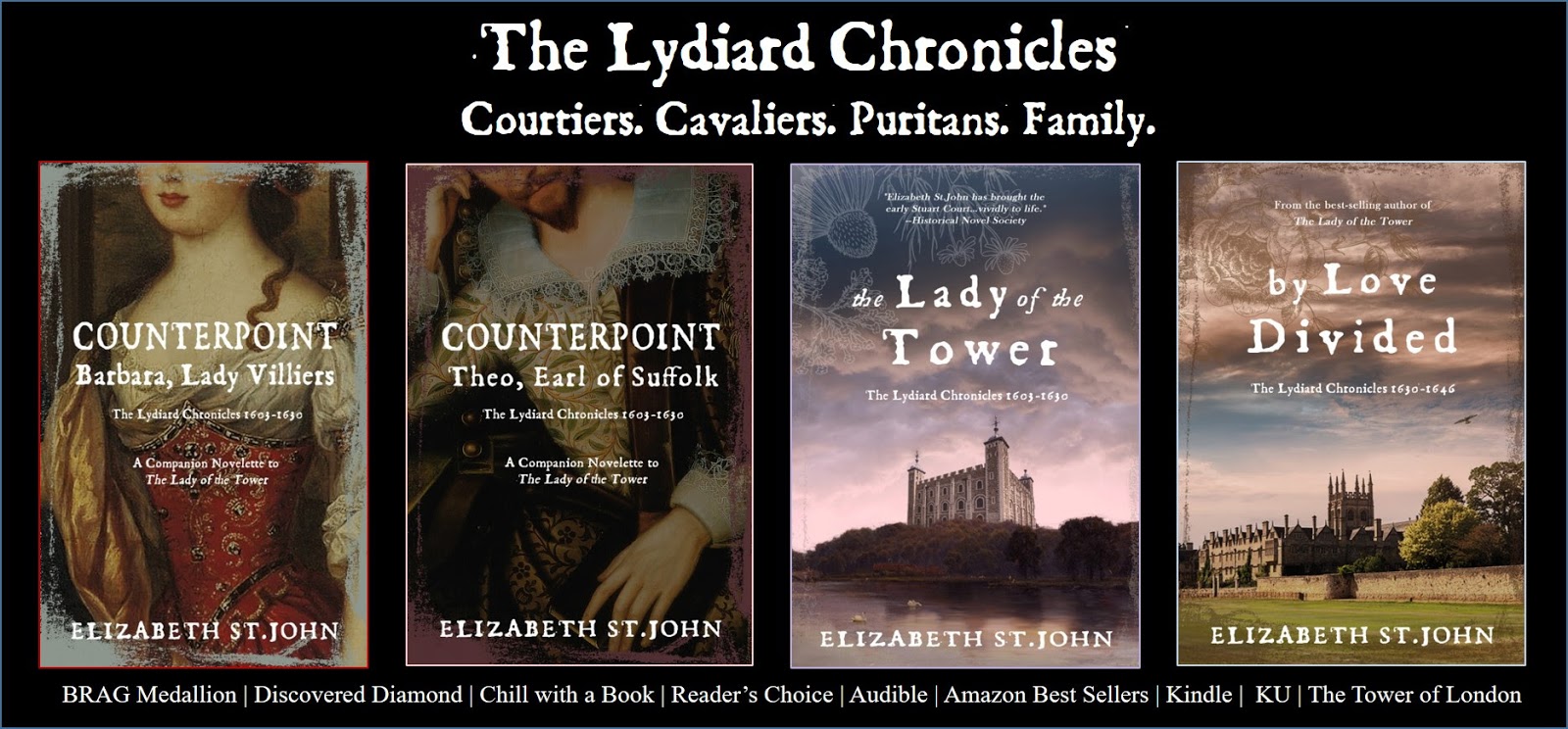
Review/Interview: Elizabeth St John, author of the Lydiard Chronicles

For those who don't know, the Lydiard Chronicles are set in the seventeenth century and concern the real life St John family, who were related to the powerful Villiers family, pivotal players at court. These are stories about real people, some of whom just happen to be the ancestors of the author. I write about much earlier times but, having studied it almost as much as the Anglo-Saxons right through to degree level, I have a deep and abiding love for the seventeenth century and enjoy reading books set in this period.


I read Books 1 and 2 - The Lady of the Tower and By Love Divided - in quick succession and decided to wait until I'd finished Book 2 before reviewing. Why? Because I read in Kindle format, and after I'd finished Book 1 I was able to read the first few pages of Book 2 and got stuck straight in!


First impressions: I'll start with the one very tiny negative. It's a personal choice, but I'm not a huge fan of books written in the first person. That's just me. I wasn't sure whether the personality of the main character would shine through but I stuck with it and I'm so glad that I did. Lucy finds her voice, her strength of character, developing all the time as she grows from girl to adult. I won't give any of the plot away, but by the time she became the Lady of the Tower, I was fully invested in her life, willing some happiness for her. (Does it come for her? You'll have to read to find out!) This is why, by the end of Book 1, I wanted to move immediately on to Book 2. By Love Divided is written in the third person, and while Lucy is still very much in the centre of things, the younger generation now also comes to the forefront. The family relationships, in all their complexity, continue to drive the plot and the characters are very well drawn indeed. Initially I wasn't sure about Barbara Villiers - could anyone be so nasty to her sister and still become a fully-drawn character? Yes, they can. And she does.


As I said, no plot spoilers. But here's a list of what's fabulous about these books: a deft sketching of time and place; the sights, sounds, smells and ways of seventeenth-century England provide an accurate backdrop to the action which brings the scenes alive. The machinations of the court and the people who thrived on such a life are depicted in all their - sordid - brilliance. The reiteration that happiness so often depended on royal favour, that middle- to high-ranking men could lose their livelihoods assisting the king and that widows were vulnerable, and not just financially. Another aspect of life shown vividly here is how often during this period, families were divided, by religion, politics, or both.

The added interest for me, especially being a writer myself, was that these novels are based not only on real people, but the ancestors of the author. I had to know more, so I got in touch with Elizabeth and asked if she'd mind answering a few questions:

AW: I know that the Lydiard Chronicles tell the story of your ancestors, but how did you come to find out about them initially?

EStJ: I grew up as an only child on the North Sea coast; during the winters, when the east wind blew in from Siberia, the casing on our old grandfather clock would open by itself, and my mother would look up from her embroidery and exclaim “here comes Uncle Brian again”. Surrounded by old family furniture, dusty letters and diaries, and flyleaf-inscribed books, the ghosts of dead relatives were far more interesting than those who were living, and I immersed myself in our family history.

My Sundays were usually spent “St.John-hunting” which usually involved traipsing around overgrown churchyards in the pouring rain, clambering over ruined castles and ancient monuments, and drinking luke-warm tea from thermos flasks. Our family tree was well-researched, and the one remaining family seat of Lydiard Park contained portraits going back to Elizabethan times. However, no-one in our family had known the story of Lucy St.John—The Lady of the Tower—and when I discovered the Memoirs in Nottingham Castle’s file cabinet, I was overjoyed. Here was the story for the book I’d always wanted to write.

AW: How wonderful to not only discover famous ancestors, but find their antics worthy of a series of novels! How much sympathy, if any, do you have for Barbara? How did you set about writing her character without making her a caricature? [pictured below: Lucy (left) & Barbara]


EStJ: I actually thought Barbara a fascinating character, and she only emerged as the main antagonist as I constructed the final plot of the book. The Memoirs describe Aunt Joan by name as being “more wicked than the tales of a stepmother”, while Lucy’s sisters were generally described as envious at her beauty. As I researched Barbara’s life, I realized that she was a very clever woman, who managed to hang on to her wealth, property and patronage after her husband’s death and the assassination of her brother-in-law, the Duke of Buckingham. She married her children into extremely influential families, and of course, her granddaughter was Barbara Villiers, Lady Castlemaine, mistress to Charles II. She knew exactly what she was doing.


I feel a great deal of responsibility to all my characters to try to write them as the real people they were, not two-dimensional caricatures. With Barbara, I wanted enough sting in her to create tension throughout the books, but still for readers to have a grudging admiration for her ability to maneuver through the perilous world of Stuart politics. Knowing the full extent of her life through the research, enabled me to write her exploits with empathy.

AW: She certainly comes across as a 'player' but also one who is at one with her choices. How familiar were you with this time period before you began researching the characters?

EStJ: I knew almost nothing about this time period, having had much more interest in Medieval and Tudor England. It was actually with a heavy heart that I started researching and writing, for as a result of our typical English education, I thought this period and the Civil War was about the most boring period of history imaginable. But, as I started to read more deeply the letters, court documents and memoirs themselves, I began to be fascinated by the incredible shift in society and politics that occurred during this time.

Along with primary sources such as Pepys and Evelyn, there were many modern biographies and non-fiction books I read that absolutely brought this home and once I was able to get a feel for the people, I realized that contextually they were all trying to survive a very uncertain world. Interestingly, I wrote The Lady of the Tower during the great recession of 2011-12, and By Love Divided during the run up to Brexit and the US Elections. Both drove home to me that the central themes of corruption and abuse of power haven’t changed much in four hundred years.

A few books I really enjoyed that made this time period really accessible:
The Weaker Vessel – Antonia Fraser
Buckingham: The Life and Political Career of George Villiers – Roger Lockyer
Shakespeare’s Restless World – Neal McGregor
The White King – Leanda de Lisle
The Killers of the King – Charles Spencer
Lucy Apsley Hutchinson's signature

And the original source for my novels:
Memoirs of the Life of Colonel Hutchinson – Lucy Hutchinson

AW: The research has certainly paid off - I felt that the seventeenth-century world was beautifully portrayed. I believe you are currently hard at work with Book 3. How far do you envisage taking the series?

EStJ: Book 3 is well underway, and as a first draft, I have a beginning, middle and end. Hoorah! You have to write that way with biographical historical fiction. This book is intended to complete the stories on this generation of the family – Lucy, Allen and Luce. However, a few new family members have decided to join the party (such as Barbara Villiers, Lady Castlemaine, and John Wilmot, Earl of Rochester), and they may decide to be the basis for another book. I took my inspiration on “Chronicles” as a title from Narnia – the stories don’t all have to be sequential, and people can come and go. I’ll just keep writing for the love of it. Who knows – maybe the medieval St.Johns will come clamoring next!

I asked Elizabeth if she could send me a picture of the magnificent Lydiard House, and here it is, in all its glory: 


Connect with Elizabeth on her website: www.elizabethjstjohn.com
and on Facebook: www.facebook.com/ElizabethJStJohn

Thursday, 15 November 2018

Review & Giveaway: Silk and the Sword by Sharon Bennett Connolly

What an ingenious concept: to examine the lives of and the roles played by the women related to the more familiar, male, characters involved in the events immediately before and after the Norman Conquest.


Silk and the Sword sensibly begins with events which far preceded those of 1066, giving the reader an introduction to the main families involved, and some background information which shows that we cannot take the events of 1066 in isolation.

This earlier history - of the powerful families of Mercia, Lady Godiva, the Godwines, and Queen Emma and both her husbands - is very familiar to me and if I'm honest there were times when I knew that there was more behind certain parts of the story, but that's me, that's not most folk. I have just had a history of Mercia published, so all my research is still very fresh in my mind. For those who are new to this period, or even those who aren't, there is plenty of meat on the bones of the story. 


Harald's wife Elisiv of Kiev,
daughter of Yaroslav the Wise
Does this mean though that there were no surprises in the book for me and nothing new to learn? Far from it. All the well-known women are here, as one would expect - Emma, Edith of Wessex, Edith 'Swanneck' - but so too are the wives of Harald Hardrada. I knew nothing about these women and I thoroughly enjoyed being whisked across the sea to learn about those close to the man described here as 'the wild card in the events of 1066'. It's easy to forget, because of his ultimate defeat, that he was a powerful ruler whose success in England, had it come, would have seen England absorbed into a Scandinavian empire. I had little idea about his royal pedigree (stretching back through his mother's line to the first king of Norway) nor, indeed, that Harald was married to two women at the same time! 

With the inclusion of Matilda of Flanders even the most ardently pro-Saxon reader will be forced to look at things from a different perspective and Gundrada de Warenne, someone I've not read about more than in passing, is given a chapter of her own and the stories behind her alleged parentage fully explored.

What I do know, because of the book that I'm currently writing, is that it is very difficult to format a book like this. Great care has been taken to skilfully extract these women from the general narrative and talk about them in isolation, whilst keeping the facts of their lives in context. 

Inevitably there is crossover, but rather than repeating herself, the author simply signposts where we are, and that we've been here before, but now we're with a different woman and we're looking at things from a different woman's perspective.

The author is keen for us to share her knowledge and interest in all the women, although I suspect she might have her favourites. Whilst she gives sympathetic and even-handed treatment to them all, I felt that there was added affection when it came to the poignancy of Edith Swanneck's tale and of Gytha, mother of the Godwine brood.

This was an ambitious project, beautifully executed and yes, as I've said, much of it very familiar to me. But the genius touch was to incorporate the stories of women from other countries because actually, it's completely logical. If you're telling the story of the women of 1066 then of course we need to know about the wives of Harald Hardrada and William of Normandy. This is where I was on less familiar ground and fascinating it was, too.

This book is a light, easy read, but it's also full of depth. Whether you are reading about these events for the first time or with a working knowledge of them, the lead-up to and the aftermath of the Conquest, with chapters entitled, for example, 'Grief and Sufferings', give an altogether different viewpoint on proceedings.

I was privileged to receive a pre-publication copy of Silk and the Sword but one lucky winner can also receive a free copy. Sharon is giving away a hardback copy of the book to readers worldwide. Simply leave a comment below - Please don't forget to leave your contact details! - and one name will be chosen at random at 7pm GMT Wednesday 21st November 2018